Theme images by kelvinjay. Powered by Blogger.

USA

AFRICA

ASIA

Brazil

Portugal

United Kingdom

Switzerland

Remains of Anglo Saxon woman and jewels discovered at university campus in Canterbury


Archaeologists have discovered the remains of an Anglo-Saxon woman, buried with lavish jewels on the University’s Canterbury campus.

Remains of Anglo Saxon woman and jewels discovered at university campus in Canterbury
The skeleton of the Anglo Saxon woman [Credit: Canterbury Archaelogical Trust]
The Canterbury Archaeological Trust (CAT) has been working on site as the University gets ready to open its Science, Technology, Health, Engineering and Medicine facilities in 2020, with a £65m building on the North Holmes campus.


The woman, believed to have been in her twenties, was found buried with a silver, garnet-inlaid, Kentish disc brooch. Scientific testing on similar finds has shown the garnets are likely to have come from Sri Lanka rather than a nearer source. Such brooches, crafted in east Kent from exotic materials, were produced at the behest of the Kentish royal dynasty and distributed as gifts to those in their favour.

Remains of Anglo Saxon woman and jewels discovered at university campus in Canterbury
The broach found with the woman's remains [Credit: Canterbury Archaelogical Trust]
She was also wearing a necklace of amber and glass beads, a belt fastened with a copper alloy buckle, a copper alloy bracelet and was equipped with an iron knife. Together, the items found in the grave suggest that this young woman was buried between AD 580-600. She would have been a contemporary, and likely acquaintance, of the Kentish King Ethelbert and his Frankish Queen Bertha, whose modern statues can be seen nearby at Lady Wootton’s Green.


“The discovery of another ancient burial on our campus is extremely exciting,” she said. “It demonstrates the richness of the archaeology that surrounds us, and contributes important new evidence to our understanding of life and death in Canterbury around 1400 years ago.”

Remains of Anglo Saxon woman and jewels discovered at university campus in Canterbury
Cremation urns were also discovered [Credit: Canterbury Archaelogical Trust]
It is possible that the woman lived long enough to be an eyewitness to the arrival of St Augustine and his monks, who came to Canterbury in AD 597 on their mission to convert the English to Christianity. But her burial, found beside Old Sessions House, close to the present boundary with St Augustine’s Abbey, almost certainly took place before the construction of the first church at St Augustine’s in the early seventh century.


Dr Andrew Richardson, Outreach and Archives Manager at CAT, said: “This discovery is particularly significant, as it suggests that relatively high-status burial was taking place on the site in the years shortly before the establishment of the Abbey.


“One of the primary roles of the Abbey was as the burial place of Augustine and his companions, Archbishops and members of the Kentish royal dynasty. This find suggests that this may represent a continuance of existing practice at the site, rather than a completely new development and has implications for our interpretation of this World Heritage site.”

The woman’s bones will be retained for further scientific study, which it is hoped will provide further insights into her life, death and burial.

Source: Canterbury Christ Church University [November 20, 2019]

European police bust gang looting artifacts in Italy


European police have busted an international crime gang involved in trafficking tens of thousands of Greek archaeological artefacts looted from illegal excavations in Italy, law enforcement agencies said Monday.

European police bust gang looting artifacts in Italy
Credit: Carabinieri TPC
Police from Italy, Britain, France, Germany and Serbia arrested 23 suspects and carried out 103 searches in the investigation that started in 2017, the EU police agency Europol and Eurojust said.


The gang used bulldozers and metal detectors to loot objects as old as 400 BC from the Calabria region -- the "toe" of Italy -- before selling them across Europe.

"Illegal excavations were managed by a well-structured organised crime group... led by two Calabrians" living in the southern province of Crotone, the agencies said in a combined statement.

European police bust gang looting artifacts in Italy
Credit: Europol
In Calabria "the cultural heritage includes important traces from the Greek and Roman period", Europol said.


Italian media said two Calabrian men aged 59 and 30 were arrested.

The gang also included "fences, intermediaries and mules operating out of different Italian regions" with the looted artefacts then going through contacts in Dijon, Munich, London and Vrsac in northeastern Serbia.

European police bust gang looting artifacts in Italy
Credit: Carabinieri TPC
Some of the stolen objects is said to date as far back as the fourth and third centuries B.C. and include five terracotta vases and oil lamps, plates depicting animal scenes, brooches and various jewels, Italian media reports said.


The looters used bulldozers to dig craters, before sifting through the earth and passing it through metal detectors, the reports added, quoting police sources.

"The looting carried out over the course of several years caused considerable damage to Italian cultural heritage," Europol and Eurojust added.

European police bust gang looting artifacts in Italy
Credit: Europol
Coordination between the two agencies enabled "arrests, searches and seizures immediately and simultaneously in the five countries," they added.

Italian and Swiss police in 2016 recovered a haul of archaeological artefacts stolen from Italy and stored by a notorious British antiquities dealer.

The haul, worth nine million euros ($10 million), was discovered in 2014 in a storage unit at the Geneva Freeport rented by Britain's disgraced Robin Symes, a giant in the illegal antiquities trade with ties to Italian tomb raiders.

At the time it was regarded as one of the most important recoveries of the last few decades.

Source: AFP [November 19, 2019]

British Museum set to return ancient Greek statue looted from Libya


London’s British Museum is set to return a looted ancient Greek statue of the goddess Persephone to Libya which is estimated to be worth £1.5m.

British Museum set to return ancient Greek statue looted from Libya
Statue of Persephone dating from 3rd century BC to be returned from the UK to Libya
[Credit: Middle East Eye]
According to Al-Wasat newspaper, Mohammed al-Kouni, the Libyan charge d’affaires, visited the British Museum along with his delegation on Thursday to see the artefact and make arrangements for its return.

Libya's cultural heritage has been under threat from looting in the turbulent years that have followed the 2011 uprising against longtime autocrat Muammar Gaddafi.

The ancient Greek statue currently in the British Museum's possession was taken from a world heritage site in Shahhat in 2012.


The piece was illegally excavated from a grave in the ruins of Cyrene, an important Hellenic city located in the north of what is now Libya, and then subsequently smuggled into the United Kingdom.

The four-foot marble relic is of a hooded woman believed to be a representation of the queen of the underworld, Persephone.

The statue dates from the third or fourth century BC, and Dr Peter Higgs, a curator of Greek sculpture at the British Museum, described it as “one of the best examples of its type and … extremely rare”.


A 2015 ruling by Judge John Zani ruled that the statue, which was in the possession of Jordanian national Riad al-Qassas, had been “misdeclared” on arrival to the UK as border officials believed it was worth £72,000 and originally Turkish.

The artefact was discovered in a west London warehouse by customs officials, before being handed to the British Museum as the court ruled on its ownership.

Qassas was ordered to pay £50,000 costs in the 2015 ruling. Meanwhile, a claim from Emirati businessman Hassan Fazeli that the statue had been in his family since 1977 was waved away.

The return is part of a drive by the Libyan Antiquities Authority to repatriate stolen goods, a process that can take many years to see fruition.


There are currently five UNESCO world heritage sites in Libya that are classified by the United Nations as endangered: Ghadames, Cyrene, Tadrart Acacus, Leptis Magna and Sabratha.

Though the North African country boasts several archaelological sites and centuries of cultural history, some regions of Libya have not yet archived or documented many of their excavated artefacts.

This has left it difficult to assess how many ancient artefacts have been looted since 2011, though it is estimated that some 8,000 ancient coins and small artefacts have been lost.

In early October, the United States returned a Libyan statue known as the “Head of a Veiled Woman” following an 11-year investigation.

Author: Haneen Shlebak | Source: Middle East Eye [November 12, 2019]

Scientists find no evidence for 'insect Armageddon' but there's still cause for concern


Researchers who set out to test the widespread theory that the UK is experiencing an alarming plunge in insect numbers have found no evidence For "insect Armageddon."

Scientists find no evidence for 'insect Armageddon' but there's still cause for concern
The large emerald (Geometra papilionaria). These moths feed on birch trees, which are very sensitive
to dry conditions and drought [Credit: Dr Callum Macgregor]
Instead, the researchers from the University of York found peaks and troughs in moth populations over a period of 50 years. They suggest changing weather patterns and climate change could be an explanation.

The study tracked the amount of moths—which the researchers measured by estimating the combined weight, or "biomass" of all moths in a given area—between 1967 and 2017. The findings reveal there is around twice the combined weight of moths in the present day compared with the 1960s.

While there has been a gradual decline in the amount of moths at a rate of around 10 percent per decade since the early 1980s, this came after a steep increase between the late 1960s and 1982.

Lead author of the study, Dr. Callum Macgregor, from the Department of Biology, said: "Moths are a good indicator of what may also be happening in other insect populations as they are the second most diverse group of insect herbivores, with a full range of species from extreme habitat generalists to extreme specialists.


"Our study does not support the narrative that insects are vanishing en masse before our eyes, because there has been a net increase in biomass over the last 50 years. However, the clear decline we observed since the 1980s is still a cause for concern.

"Moths come in all shapes and sizes, so measuring their combined weight allowed us to analyze changes in their populations that are relevant to their predators and food plants."

Co-author Professor Chris Thomas, from the Department of Biology at the University of York, added: "Biomass is particularly important because it is linked to ecosystem processes, such as the total amount of plant material consumed by insects and food availability for other animals that eat insects.

"Moths provide pollination nocturnally to a wide range of plants, and they provide food for birds, bats and small mammals. Their survival is crucially important to the rest of life on earth."

Better data

The authors investigated the possible reasons behind the fluctuations in insect populations, and why the results of the study might differ from the conclusions of previous research.

Scientists find no evidence for 'insect Armageddon' but there's still cause for concern
Elephant hawk-moth (Deilephila elpenor)has declined by 11% over the last 50 years,
according to Rothamsted Insect Survey data [Credit: Dr Callum Macgregor]
According to the researchers, the use of better and longer-term data may be part of the answer: To put "Insectageddon' to the test, they analyzed data from "perhaps the best insect population database available anywhere in the world"—the Rothamsted Insect Survey's national network of light-traps.

The data allowed them to estimate the weight of moths caught each year at 34 different sites around the UK between 1967 and 2017. Co-author Dr. James Bell from the Rothamsted Insect Survey explained: "Since 1964, the Rothamsted Insect Survey has been at the forefront of the insect declines research, exploiting the longest standardized terrestrial insect time series in the world.

"Even though we have reported on population change in aphids, moths, ladybirds, wasps and general insect biomasses for decades, this study represents a major advance in our understanding."

Driving force

Two of the most commonly suggested causes of "Insectageddon' are agricultural intensification and, for night-flying insects like moths, light pollution. However, the researchers found no evidence that agricultural practices or urban light pollution are the main driving force behind this recent decline.


The researchers categorized the moth trap sites into four land use types: woodland, grassland, arable and urban, and found that land use type (as well as changes over time in land use) had little impact on the pattern of increase and decline.

Dr. Macgregor commented: "If pesticides were causing the problem you would expect to see the biggest decline in arable landscapes; likewise, if it was light pollution, the biggest decline would be in urban environments. We found neither of these to be the case—in fact, the habitats with the biggest decline were woodland and grassland."

Extreme weather events

Changing weather patterns and climate change could be an explanation, the researchers say. Sharp increases in the amount of moths in the late 1970s came soon after one of the hottest, driest years on record. Disturbance from extreme weather events can sometimes cause equally extreme and unpredictable population changes in insects, including both increases and declines.

Scientists find no evidence for 'insect Armageddon' but there's still cause for concern
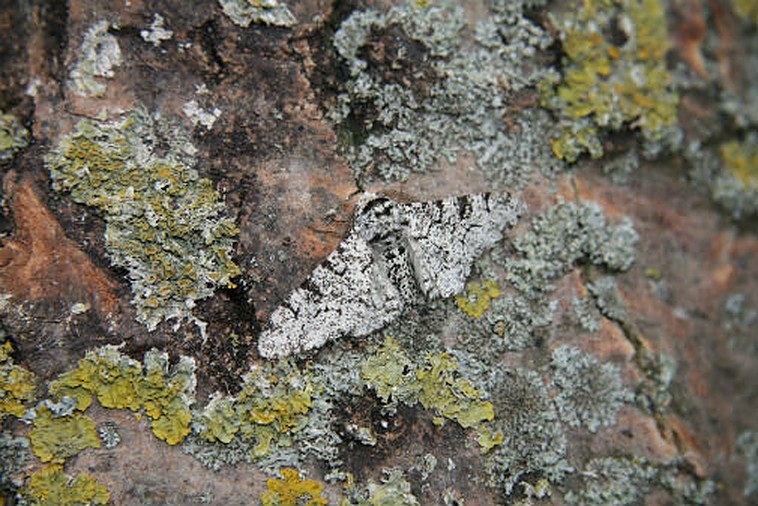
Peppered moth biston betularia has declined by 81% over the last 50 years,
according to Rothamsted Insect Survey data [Credit: Callum Macgregor]
Whether climate is contributing to the more recent decline requires further investigation; rising average annual temperatures and rainfall patterns did not match up with the peaks and troughs in moth populations, but extreme weather events—from deluge and flooding to heatwaves and drought—are often not reflected in average climate records.

The post-1982 decline appears to be real, but the researchers concluded that the reasons for this ecological decline are not as straightforward as is sometimes suggested.

"There is no simple explanation and more research on long-term data sets is required" added Professor Thomas. "We found that short-term studies and infrequent sampling can give erroneous estimates of biomass change. The complexity of insect population change requires more, better and longer-running data if we are to draw robust conclusions, particularly for parts of the world where insect data are limited."

The study is published in Nature Ecology & Evolution.

Author: Shelley Hughes | Source: University of York [November 11, 2019]

British Museum is 'world’s largest receiver of stolen goods', says leading human rights lawyer


An outspoken human rights lawyer in a new book is calling for European and US institutions to return treasures taken from subjugated peoples by “conquerors or colonial masters.”

British Museum is 'world’s largest receiver of stolen goods", says leading human rights lawyer
Section of the Parthenon frieze helf by the British Museum
[Credit : PHAS/Universal Images Group, Getty]
In the new book by Geoffrey Robertson AO QC, the British Museum is accused of exhibiting “pilfered cultural property” and urged to ‘wash its hands of blood and return Elgin’s loot’.

“The trustees of the British Museum have become the world’s largest receivers of stolen property, and the great majority of their loot is not even on public display,” Robertson charges.

His views appear in the book, “Who Owns History? Elgin’s Loot and the Case for Returning Plundered Treasure.”


Along with a distinguished career as a trial lawyer, human rights advocate and United Nations judge, Robertson has appeared in many celebrated trials, defending Salman Rushdie and Julian Assange, prosecuting Hastings Banda and representing Human Rights Watch in the proceedings against General Pinochet.

In his just released book, he scores the British Museum for allowing an unofficial “stolen goods tour”, “which stops at the Elgin marbles, Hoa Hakananai’a, the Benin bronzes and other pilfered cultural property”. The three items he mentioned are wanted by Greece, Easter Island and Nigeria respectively.

“That these rebel itineraries are allowed is a tribute to the tolerance of this great institution, which would be even greater if it washed its hands of the blood and returned Elgin’s loot,” he wrote.

British Museum is 'world’s largest receiver of stolen goods", says leading human rights lawyer

He accused the museum of telling “a string of carefully-constructed lies and half- truths” about how the marbles “were ‘saved’ or ‘salvaged’ or ‘rescued’ by Lord Elgin, who came into possession of them lawfully.”

He criticized “encyclopedic museums” such as the British Museum, the Louvre in Paris and the Metropolitan in New York that “lock up the precious legacy of other lands, stolen from their people by wars of aggression, theft and duplicity”.


“This is a time for humility,” he observed, “something the British, still yearning for the era when they ruled the world do not do very well. Before it releases any of its share of other people’s cultural heritage, the British Museum could mount an exhibition – ‘The Spoils of Empire’.”

Advocating the return of cultural property based on human rights law principles, Robertson observes that the French president, Emmanuel Macron has “galvanized the debate” by declaring that “African cultural heritage can no longer remain a prisoner of European museums”.

“Politicians may make more or less sincere apologies for the crimes of their former empires, but the only way now available to redress them is to return the spoils of the rape of Egypt and China and the destruction of African and Asian and South American societies,” he writes.

“We cannot right historical wrongs – but we can no longer, without shame, profit from them.”

Author: Lisa Vives | Source: Global Information Network [November 06, 2019]

New study suggests the original location of the Bayeux Tapestry is finally solved


New evidence, published in the Journal of the British Archaeological Association, has confirmed that the Bayeux Tapestry was designed specifically to fit a specific area of Bayeux's cathedral.

New study suggests the original location of the Bayeux Tapestry is finally solved
Part of the junction of Pieces III and IV of the Bayeux Tapestry [Credit: Detail of the Bayeux Tapestry,
11th century, with special permission from the City of Bayeux]
New research suggests the Tapestry was designed to be hung along the north, south and west sides of the nave of Bayeux Cathedral, between the west wall and choir screen. It has long been known that the Tapestry was hung in the cathedral in the fifteenth century, but new analysis of the linen strips on which it is embroidered suggests that it was intended to hang there from the moment it was made in the eleventh century.


This discovery proves that the designer must have visited Bayeux and known the nave's exact dimensions, adjusting the design accordingly.

The findings shed light on how the artwork, depicting one of British history's most famous stories, should be displayed ahead of its loan to the UK.

New study suggests the original location of the Bayeux Tapestry is finally solved
Diagram of the layout of the Bayeux Tapestry as originally displayed in the nave of the cathedral
[Credit: Journal of the British Archaeological Association]
For centuries, there has been debate around where the Bayeux Tapestry was manufactured, who commissioned the embroidery and whether it was originally displayed in England or France. Questions have also persisted over its exact dimensions, and the specific venue it was made for.


"It has always been the case that the simplest explanation is that it was designed for Bayeux Cathedral," says author Christopher Norton from the University of York. "This general proposition can now be corroborated by the specific evidence that the physical and narrative structure of the tapestry are perfectly adapted to fit the (liturgical) nave of the 11th-century cathedral."

Professor Norton's research is based on mathematical calculations, analysis of documentary evidence including of the Tapestry's linen fabric, and of surviving architectural details. Published data on the Tapestry's measurements was assessed and compared along with information on medieval cloth sizes, allowing for factors such as shrinkage and missing sections.

New study suggests the original location of the Bayeux Tapestry is finally solved
The position of the tapestry as shown on a reconstructed plan of Bayeux Cathedral
 in the late eleventh century based on Vallery-Radot 1923 and 1958
[Credit: Stuart Harrison]


By studying the cathedral's surviving architectural features, Professor Norton also established how the nave would have looked in the 11th century. This enabled him to establish the nave's original proportions by pinpointing the choir screen's location - the Tapestry would have fitted five bays of the nave, with the artwork's 'narrative' deliberately structured in relation to doorways and architectural supports.

He recommends that the Tapestry, currently kept in a long U-shaped tunnel, should be displayed along three sides of a rectangular space (31.15 m long x 9.25 m wide). This would evoke the original architectural setting, he adds, and enable viewers to appreciate the artwork as intended.

The findings arrive with the news that the embroidery is set to be lent to Britain (possibly in 2022) for the first time in recorded history, following a promise made by President Macron last year. The upcoming exhibition of the Tapestry, documenting the 1066 Norman conquest of England, has huge significance in UK-European relations - especially as it will go on public exhibition post-Brexit.

Source: Taylor & Francis Group [October 23, 2019]

Face of a Medieval man found in Aberdeen reconstructed


The face of a Medieval man whose remains were found in Aberdeen has been reconstructed. The man - known as skeleton 125 - was one of 60 full skeletons and more than 4,000 human bone fragments found after work began at the Aberdeen Art Gallery redevelopment site.

Face of a Medieval man found in Aberdeen reconstructed
Skeleton 125 has been reimagined by experts after a 60 skeleton discovery in Aberdeen
[Credit: AOC Archaeology Group]
Testing indicated the man was over the age of 46 and shorter than average. The researchers - AOC Archaeology Group - said he had suffered from extensive dental disease.


Dr Paula Milburn, from AOC Archaeology, described the work as providing a "fascinating glimpse" into the lives of Aberdonians 600 years ago.

Face of a Medieval man found in Aberdeen reconstructed
The man was said to have suffered from extensive dental disease
[Credit: AOC Archaeology Group]
Dr Milburn said: "The ongoing post-excavation work is examining the remains in detail and will provide us with amazing information on the kind of people buried here, including their ages, gender, health and lifestyles."

She said research also indicated that the man possibly spent his childhood in an area such as the north-west Highlands or Outer Hebrides.

Source: BBC News Website [October 22, 2019]

The largest ever Bronze Age hoard found in London


The largest ever Bronze Age hoard to be discovered in London, the third largest of its kind in the UK, has been unearthed in Havering. This hugely significant find will go on display for the first time as the focal point of a major exhibition at the Museum of London Docklands in April 2020.

The largest ever Bronze Age hoard found in London
The hoard is the third largest unearthed in the UK
[Credit: Museum of London/PA]
A total of 453 bronze objects dating between c.900 and c.800 BC have been uncovered during a planned archaeological investigation, with weapons and tools including axe heads, spearheads, fragments of swords, daggers and knives found alongside some other unusual objects, which are rarely found in the UK.

Almost all the weapons appear to be partially broken or damaged, raising questions as to why these objects ended up being carefully buried in groups close together. The deliberate placement of these items may suggest a specialist metal worker operated in this area, and this large scale deposit of bronze may represent an accumulation of material akin to a vault, recycling bank or exchange. Could this treasure have been a religious offering, were they hoping to recycle the metal, control access to the material, or did Bronze Age tools lose their value with the emergence of iron technology?


Objects from the hoard and an in-depth look into these questions will be presented to the public for the first time next year at the Museum of London Docklands. All the archaeological work was agreed with and closely monitored by Historic England, assisted by the Portable Antiquities Scheme, and further conservation and analysis of the artefacts is currently underway which will reveal more insights into this incredible find.

Roy Stephenson, London’s Historic Environment Lead at the Museum of London, said: “We’re thrilled to be able to display this momentous discovery for the first time at the Museum of London Docklands as the centrepiece of a major exhibition in April 2020.

The largest ever Bronze Age hoard found in London
Excavation of the Havering hoard [Credit: Archaeological Solutions Ltd]
It’s incredibly rare to have uncovered a hoard of this size on one site. This discovery is of huge importance and raises questions as to why this treasure was buried in this way and why it was never recovered? These questions and more will be investigated in the exhibition at the Museum of London Docklands next year.”

Duncan Wilson, Chief Executive of Historic England, said: “This extraordinary discovery adds immensely to our understanding of Bronze Age life. It also underlines the importance of planned assessment and, when appropriate, excavation in archaeological hotspots when new development comes along. The opportunity to investigate here and ultimately unearth the remarkable hoards that have come to light was only possible because of the effective partnership between archaeologists and developers.


The finds have already taught us a great deal about this distant age, and on-going analysis and public outreach means that many more people will benefit from this window into the past thanks to this example of successful development-led archaeology.”

Andrew Peachey, Specialist in Prehistoric and Roman Pottery at Archaeological Solutions, said: “The excavation has been an unprecedented opportunity and experience for our team to be able to excavate these intricate bronze hoards in such a valuable context.  The setting of many hoards is often unclear, but these were deliberately placed and aligned within a late Bronze Age enclosure so that we could excavate them in their entirety.

The largest ever Bronze Age hoard found in London
An axe from the Havering hoard [Credit: Museum of London/PA]
The location of the enclosure and hoards, overlooking the river Thames, made for a dramatic setting, especially as the sun rose and set, highlighting that in prehistory this would have been a special location. We are very grateful for the continued support of Ingrebourne Valley Ltd and look forward to further specialist analysis of the finds and working with the Museum of London on an exhibition to bring new life to old bronzes.”

Peter Stewart, Chair of the Havering Museum, said: “Havering Museum is very proud to be associated with the Museum of London and to be given the opportunity of displaying artefacts from the incredible Bronze Age hoard following the major exhibition at the Museum of London Docklands. The Hoard is hugely significant in the long history of Havering and London and will prove to be a great attraction and educational resource for both museums.”

Source: Havering Museum [October 21, 2019]

Human remains and ‘lavish’ jewels unearthed at Anglo-Saxon burial site in Lincolnshire


Skeletons and ‘lavish’ artefacts have been unearthed at an historic burial site in the county. Archaeologists have been left stunned by the findings - which include 50 graves containing human remains, jewellery and weaponry.

Human remains and ‘lavish’ jewels unearthed at Anglo-Saxon burial site in Lincolnshire
One of the skeletons unearthed at the Anglo-Saxon burial site in Scremby
[Credit: Sheffield University]
A team from Sheffield University, which led the excavations, made the astonishing discoveries at a sixth century Anglo-Saxon burial site in a field at Scremby, between Skegness and Spilsby.


The ancient cemetery was first discovered when a metal detectorist scanning the farmland uncovered Anglo-Saxon objects including iron shield bosses, copper guilded brooches and spear heads. Ploughing had damaged some of the graves before their existence was known - but many survived intact.

Human remains and ‘lavish’ jewels unearthed at Anglo-Saxon burial site in Lincolnshire
The fully-preserved enamelled bowl unearthed at the Anglo-Saxon burisl site at Scremby - is one
of the most impressive finds [Credit: Sheffield University]
Human remains and ‘lavish’ jewels unearthed at Anglo-Saxon burial site in Lincolnshire
An ornate brooch recovered from one of the fifth century graves
[Credit: Sheffield University]
The excavations that followed have now unearthed 50 ancient graves - many representing what archaeologists call the ‘lavish burials’ of wealthy individuals at the time. Tragically, one woman buried at the site was found cradling the remains of a baby in her arms.

Archaeologists behind the latest dig, which took place this summer, are now in the process of cleaning and analysing their various finds. Items include human bones and teeth, jewellery such as intricate glass beads and brooches, weapons, and ornate pottery - including a well-preserved enamelled bowl.

Human remains and ‘lavish’ jewels unearthed at Anglo-Saxon burial site in Lincolnshire
A metal boar's head with garnet eyes - which may have been the nose piece on a helmet
[Credit: Sheffield University]
Human remains and ‘lavish’ jewels unearthed at Anglo-Saxon burial site in Lincolnshire
This 'rare' bird shield mount was unearthed at the Scremby site
[Credit: Sheffield University]
Lead archaeologist Dr Hugh Willmott describes the bowl as ‘a major find in its own right’ - with the carefully cleaned-up object revealing ‘stunning coloured enamels’.


Speaking to the Standard, he said: “We have a series of burials, 50 in total, what all include some form of grave goods. These can vary from just a single knife to hundreds of beads. The male burials often are accompanied by weapons in the forms of spears and shields, whilst the female burials largely contain jewellery such as brooches, beads and buckles. Some of the most eye-catching are the beads which are made from coloured glasses, rock crystal and amber.”

Human remains and ‘lavish’ jewels unearthed at Anglo-Saxon burial site in Lincolnshire
The archaeology team carefully unearth an ancient knife (seax)
[Credit: Sheffield University]
Human remains and ‘lavish’ jewels unearthed at Anglo-Saxon burial site in Lincolnshire
Some of the beads and a spindle whorl which were found at the burial site
[Credit: Sheffield University]
The human bone fragments and teeth have now been sent off for analysis using ‘ancient DNA sequencing’.

This is the second dig at Scremby by the team, having begun early excavations at the site last year. During this time they found artefacts such as a metal boar’s head with garnet eyes - which may have been the nose piece on a helmet - a ‘rare’ bird shield mount, a copper-alloy cup, and an animal-themed decorated belt fitting.

Human remains and ‘lavish’ jewels unearthed at Anglo-Saxon burial site in Lincolnshire
The dig in progress at Scremby this summer
[Credit: Sam Bromage]
Dr Willmott says they have now finished excavating the site, as there is ‘nothing left’ to find.

Writing about the dig, he added: “The preservation of the skeletal remains, as well as the many grave finds, provide an exciting opportunity to explore the social and cultural dynamics of the community who chose to bury their dead on this chalky outcrop.”

Author: Gemma Gadd | Source: Skengess Standard [October 17, 2019]

Britain’s earliest mining boom revealed


Britain’s earliest mining boom was far earlier than previously thought after a study of the Great Orme Bronze Age copper mine on the coast of North Wales indicated that large scale copper production took place for a couple of centuries, over 3,500 years ago.

Britain’s earliest mining boom revealed
Aerial view of the Great Orme mine site looking south-east towards Llandudno
[Credit: © Great Orme Mines Ltd/Antiquity]
Research by Dr Alan Williams, in the University of Liverpool’s Department of Archaeology, Classics and Egyptology, reveals that, not only did the mine produce enough copper to dominate Britain’s metal supply for about two centuries but there was enough metal for trading or exchange with Ireland, and across continental Europe from France to Sweden.


The Great Orme Bronze Age copper mine’s extraordinary complex of ancient underground tunnels was discovered in 1987, and nineteen radiocarbon dates suggest that the mine was worked for around eight centuries, from the late Early Bronze Age to the Late Bronze Age (c.1700–900 BC).

More than 2,400 hammerstones have been recovered, along with over 30,000 pieces of bone, many of which were used as mining tools along with bronze tools. Despite the large scale of archaeological remains, it was previously thought that the mine could not have been a major source of metal for Bronze Age Britain because the metal it produced was too low in impurities, compared to the high levels of impurities present in most Bronze Age metal artefacts. It was claimed the mine only became large after being worked on a small scale for a millennia.

Britain’s earliest mining boom revealed
Continental distribution map of bronze shield-pattern palstave axes and those analyzed
are all consistent with Great Orme metal [Credit: R. A. Williams/Antiquity]
But Dr Williams, and his co-author Cecile Le Carlier de Veslud at the Universite de Rennes, sought to prove otherwise. They created a methodology based on extensive sampling and analysis of ores from the Great Orme mine and combined this with smelting experiments, to establish the chemical and lead isotopic ranges of the metal the ores would have produced and then compared them with existing databases of Bronze Age artefacts.


They were able to define chemical and isotopic ‘fingerprints’, which identified that the artefacts are consistent with Great Orme metal (for example, shield-pattern palstave axes) and the period during the Bronze Age when the metal was dominant.

The results suggest there was a ‘golden age’ of ore production at Great Orme, c. 1600–1400 BC, followed by a ‘twilight period lasting many centuries’, during which only small amounts of ore were produced after the two richest areas had been exhausted. This twilight period explains the later radiocarbon dates stretching from 1400–900 BC.

Britain’s earliest mining boom revealed
The entrance to the Bronze Age Great Orme copper mine
[Credit: Alan Simkins/WikiCommons]
During the period of large-scale production there must have been considerable organisation of the many mining and smelting tasks as well as coordination of substantial resources, including obtaining tin from Cornwall to combine with the copper to make bronze (90% copper, 10% tin). This scale of activity suggests a full-time mining community was present, possibly supported or controlled by communities in the agriculturally richer area of northeast Wales.

These Bronze Age miners made Britain self-sufficient in copper for the first and only time in the Bronze Age, and British copper was transported by sea to an area stretching from Brittany to as far as the Baltic. This new evidence suggests that Britain was much more closely integrated into European Bronze Age trade and exchange networks than archaeologists had previously suspected.

The full report is available from Antiquity Journal.

Source: University of Liverpool [October 15, 2019]

Oxyrhynchus papyri sold by renowned professor to Hobby Lobby


A number of ancient papyri from Oxyrhynchus, part of the Egypt Exploration Society’s collection, have been identified as part of the lot allegedly offered for sale by Professor Dirk Obbink to the American chain Hobby Lobby. The Society has issued a statement on the matter.

Oxyrhynchus papyri sold by renowned professor to Hobby Lobby
The ancient texts, which date from the 3rd to the 7th Century, are part of the Oxyrhynchus collection
discovered in an Egyptian rubbish dump in 1890 [Credit: The Egypt Exploration Society]
“On 25 June 2019 the Egypt Exploration Society (EES) posted a statement on its website that it was working with the Museum of the Bible (MOTB) to clarify whether any texts from the EES Oxyrhynchus collection had been sold or offered for sale to Hobby Lobby or its agents, and if so, when and by whom. This was in response to the online publication by Dr Brent Nongbri, following its release by Professor Michael Holmes of the MOTB, of a redacted copy of a contract of 17 January 2013 between Professor Dirk Obbink and Hobby Lobby Stores for the sale of six items to Hobby Lobby, including four New Testament fragments probably of EES provenance. This statement reports our findings to date.


“With the help of photographs provided by the MOTB, the EES has so far identified thirteen texts from its collection, twelve on papyrus and one on parchment, all with biblical or related content, which are currently held by the MOTB (see the attached list). These texts were taken without authorisation from the EES, and in most of the thirteen cases the catalogue card and photograph are also missing. Fortunately, the EES has back-up records which enable us to identify missing unpublished texts. For clarity, we note that the four texts specified in the handwritten list made public alongside the 2013 contract, which are probably the texts of that contract, remain in the EES collection, and two have been published as P.Oxy. LXXXIII 5345 and 5346.

“The Board of Trustees of the MOTB has accepted the EES claim to ownership of the thirteen pieces identified to date, and is arranging to return them to the EES. The EES is grateful to the MOTB for its co-operation, and has agreed that the research on these texts by scholars under the auspices of the MOTB will receive appropriate recognition when the texts are published in the Oxyrhynchus Papyri series.

Oxyrhynchus papyri sold by renowned professor to Hobby Lobby
Professor Dirk Obbink has been accused of selling the precious artefacts to Steve Green,
who spent $500,000 opening the museum in 2017 [Credit: The Telegraph]
“The MOTB has informed the EES that 11 of these pieces came into its care after being sold to Hobby Lobby Stores by Professor Obbink, most of them in two batches in 2010. In August 2016 the EES did not re-appoint Professor Obbink as a General Editor of the Oxyrhynchus Papyri primarily because of unsatisfactory discharge of his editorial duties, but also because of concerns, which he did not allay, about his alleged involvement in the marketing of ancient texts, especially the Sappho text. In June 2019 the EES banned him from any access to its collection pending his satisfactory clarification of the 2013 contract. Oxford University is now investigating, with EES help, the removal from University premises and alleged sale of EES texts.

“The EES is also pursuing identification and recovery of other texts, or parts of texts, which have or may have been illicitly removed from its collection. Systematic checking of the EES collection will be a long process because of its size. Meanwhile, our primary aim remains the authoritative publication for public benefit of the texts of all types in our collection.

“We cannot comment here on any broader legal issues arising from these findings, except to note that they are under consideration by all the institutions concerned."

Source: Egyptian Exploration Society [October 14, 2019]

Airborne laser scan reveals 1,000 ancient sites on Scottish island


A cutting-edge archaeological project using innovative technology has revealed around 1,000 previously unknown archaeological sites on the Isle of Arran.

Airborne laser scan reveals 1,000 ancient sites on Scottish island
Post-medieval shielings - temporary huts - in Glen Iorsa
[Credit: Historic Environment Scotland]
The project, undertaken by archaeologists at Historic Environment Scotland (HES), used airborne laser scanning, also known as lidar, to document the land surface in 3D. The survey is the largest of its type so far in Scotland and has detected the remains of ancient monuments on the island.

Airborne laser scan reveals 1,000 ancient sites on Scottish island
A medieval roundhouse is among new sites to emerge from the landscape
[Credit: Historic Environment Scotland]
Previously unknown ancient archaeological sites which have been discovered include prehistoric settlements and medieval farmsteads, as well as a Neolithic cursus monument - an exceptionally rare find on the west coast of Scotland.


Dave Cowley, Rapid Archaeological Mapping Manager at HES, said: "This survey has shown us that there are double the number of ancient monuments on Arran than we previously knew about. This new 3D technology has allowed us to undertake a rapid archaeological survey, over weeks rather than months or years, and allowed us to discover sites that might even have been impossible to find otherwise."

Airborne laser scan reveals 1,000 ancient sites on Scottish island
Details of mine workings revealed by the survey
[Credit: Historic Environment Scotland]
"We have been able to see how densely settled parts of Arran were, and the medieval and post-medieval shieling sites that were discovered have told us how upland areas were used by shepherds. This is an exciting time to be involved in the development of remote sensing and archaeological mapping."

Airborne laser scan reveals 1,000 ancient sites on Scottish island
The airborne surveys allowed the landscape to be studied in a relatively short time
[Credit: Historic Environment Scotland]


"We are exploring the benefits of new technology and new datasets to record Scotland’s historic environment and inform our knowledge of the past. As a result, we are enriching the information through which we tell Scotland’s story. And Arran is just a first step. As this technology become more widely available, we expect to find tens of thousands more ancient sites across the rest of Scotland – working at a pace that was unimaginable a few years ago."


The lidar data is available from the Scottish Government Remote Sensing Portal. Shona Nicol, Head of the Geographical Information Science and Analysis team said: "It is great to see HES making such exciting use of the increasing amount of remote sensing data becoming available which will help to play a part in keeping Scotland at the forefront in this field."

Source: Historic Environment Scotland [October 11, 2019]

Research reveals secret of who owned the Galloway Hoard


First research into the Galloway Hoard has uncovered the name of one of the famous treasure’s original owners. Examination of Anglo-Saxon runic inscriptions on the Hoard’s silver arm-rings have revealed the name “Ecgbeorht” or, in its more modern form, Egbert.

Research reveals secret of who owned the Galloway Hoard
Ecgbeorht rune on silver arm-ring [Credit: National Museums Scotland]
Dr Adrian Maldonado, Glenmorangie Research Fellow at National Museums Scotland, said: "It’s really exciting to be able to reveal the first major research finding from the conservation of the Galloway Hoard, a message left by one of the individuals who deposited the hoard 1100 years ago.
We don’t know any more about Egbert than his name right now but there’s something really tantalising about connecting the Galloway Hoard with a named person. Egbert is a common Anglo-Saxon name, and with more research on the rest of the contents of the hoard, we will be able to narrow down its dating and suggest some candidates from the historical record."


"If the hoard belonged to a person or group of Anglo-Saxon speakers, does it mean they were out raiding with other Vikings? Or that these Viking hoards were not always the product of Scandinavian raiders? There are other explanations, but either way this transforms our thinking on the ‘Viking Age’ in Scotland."

"These inscriptions are evidence that identity was complex in the past, just as it can be today. In Early Medieval Scotland, we have inscriptions in five different scripts (Latin, ogham, Pictish symbols, Scandinavian and Anglian runes) making it a diverse and multilingual era. Place-names in British, Gaelic, Norse and Old English were being coined in South West Scotland around the time of the Galloway Hoard.  The sea was more like a motorway, allowing people to communicate across linguistic boundaries, exchanging ideas and objects. This is just a glimpse of how the Galloway Hoard will continue to challenge our thinking as conservation continues."

Research reveals secret of who owned the Galloway Hoard
Flattened silver arm-rings [Credit: National Museums Scotland]
The runes were read by Dr David Parsons of the University of Wales. He said: "Five of the silver arm-rings have runic inscriptions scratched into them which may have functioned as labels identifying distinct portions of the hoard, perhaps recording the names of the people who owned and buried them. Arm-rings of this sort are most commonly associated with Viking discoveries around the Irish Sea coastlands. Yet these runes are not of the familiar Scandinavian variety common around this date on the nearby Isle of Man, but of a distinctively Anglo-Saxon type. And while several of the texts are abbreviated and uncertain, one is splendidly clear: it reads Ecgbeorht, Egbert, a common and thoroughly Anglo-Saxon man’s name."


"There is some reason, therefore, to suspect that the Galloway ‘Viking’ Hoard may have been deposited by a people who, to judge by name and choice of script, may have considered themselves part of the English-speaking world. It is even possible that these were locals: Galloway had been part of Anglo-Saxon Northumbria since the early eighth century, and was referred to as the ‘Saxon coast’ in the Irish chronicles as late as the tenth century."

As well as the arm-ring with the full name of Egbert, four others have runic inscriptions. Three appear to be abbreviated names, probably also Old English, whilst the fifth has still to be deciphered, but all are in Anglo-Saxon runes

Research reveals secret of who owned the Galloway Hoard
Objects from the Galloway hoard [Credit: National Museums Scotland]
The Galloway Hoard brings together the richest collection of rare and unique Viking-age objects ever found in Britain or Ireland. It is of international significance and will transform our understanding of this period of Scottish history. Buried at the beginning of the tenth century, it comprises in excess of 100 gold, silver and other items, some of which are unique.

The Hoard was discovered in 2014.  Following its acquisition by National Museums Scotland in 2017, the Hoard is currently being conserved and researched at the National Museums Collection Centre in Edinburgh.

An exhibition of the Galloway Hoard will be displayed at the National Museum of Scotland in May, and will tour thereafter to Kirkcudbright Galleries, The McManus: Dundee’s Art Gallery and Museum and Aberdeen Art Gallery thanks to funding from the Scottish Government.

Following the tour part of the Galloway Hoard will be on long-term display at the National Museum of Scotland in Edinburgh with a significant and representative portion of the Hoard also displayed long-term at Kirkcudbright Galleries.

Hamish Torrie, Corporate Social Responsibility Director at The Glenmorangie Company, said: "This latest reveal from the Galloway Hoard adds yet another layer of understanding as to the make-up of the early people of Scotland and we are delighted that this research can benefit from our support."

Source: National Museums Scotland [October 05, 2019]