Theme images by kelvinjay. Powered by Blogger.

USA

AFRICA

ASIA

Brazil

Portugal

United Kingdom

Switzerland

5,000-year-old pyramid-like structure found in northern Peru


A pyramid-like structure at least 5,000 years old, allegedly devoted to ceremonial purposes, was unveiled thanks to excavation works conducted at Sechin archaeological complex in Casma Province of Ancash Region in northern Peru.

5,000-year-old pyramid-like structure found in northern Peru
Credit: Andina
It is a stepped structure, at least 3.20 metres high and 5 metres wide. Sechin Archaeological Project archaeologists and workers had to excavate some 6 metres of soil and remove stones in order to unearth it.


Archaeologist Monica Suarez, coordinator at Sechin Archaeological Project, commented that the pyramid is located within the south-central part of the main building. It is believed that it was used for ceremonial purposes.

5,000-year-old pyramid-like structure found in northern Peru
Credit: Andina
"It is of great importance in these ceremonial sites. It served a ceremonial purpose, but we need to make further analysis (…)," she said in statements to Andina news agency.


Additionally, the team of researchers discovered two skulls —one of an adult and one of a child— and a dismembered body on the side, which makes the theory of ceremonial practices gain traction.

5,000-year-old pyramid-like structure found in northern Peru
Credit: Andina
The researcher stressed the possibility that the stepped, pyramid-shaped structure served as a ladder to get to a higher level.

"There is an adobe wall at the top, with fingerprints of Sechin inhabitants visible in the mud. They are believed to be a symbol of their work," she said.

Source: Andina [November 21, 2019]

143 new Nazca geoglyphs discovered


Located in the Nazca Desert in southern Peru, the Nazca Lines are a collection of giant etchings that only make sense from a great height. Now AI is helping speed up the hunt for more hidden symbols -  and has already had some success.

143 new Nazca geoglyphs discovered
A newly discovered geoglyph, left, in Peru's Nazca Lines has human form. The image, right, offers a clearer
picture of what it depicts. The black rule at the bottom of the photo shows it is 4 meters wide
[Credit: Yamagata University]
Since their discovery in the 1920s, the Nazca Lines have continued to mystify experts. Created between 200 BCE and 600 CE, they were made by removing stones to reveal the white sand beneath and depict various geometric shapes, people, and animals, known as geoglyphs. In 1994 they were designated a UNESCO World Heritage Site, but their purpose and meaning have continued to elude historians.


In 2004, a team led by Masato Sakai at Yamagata University in Japan began a concerted effort to map out all the lines in the hopes of preserving them and understanding their significance. Through over a decade of fieldwork and the analysis of high-resolution 3D data, the team has uncovered 142 new designs, it announced this week.

143 new Nazca geoglyphs discovered
A geoglypth of a human figure, left, was discovered using AI technology. The image, right,
 gives a clearer of idea of its shape [Credit: Yamagata University]
143 new Nazca geoglyphs discovered
A geoglyph of what appears to be rat with a human figure on the right side
[Credit: Yamagata University]
143 new Nazca geoglyphs discovered
A cat-like geoglyph [Credit: Yamagata University]


The geoglyphs fall into two main categories. Larger animal-like designs, as long as 100 meters (330 feet), were likely used to demarcate places of ritual. Smaller symbols, some smaller than 5 meters (16 feet), probably served as waypoints for travelers.

143 new Nazca geoglyphs discovered
This geoglyph is thought to depict a human
[Credit: Yamagata University]
143 new Nazca geoglyphs discovered
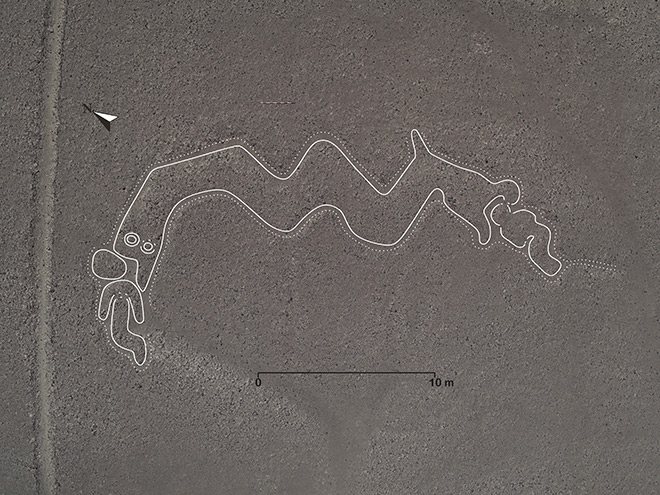
This image appears to be a two-headed snake feasting on humans
[Credit: Yamagata University]
143 new Nazca geoglyphs discovered
A geoglyph of what appears to be a human head headdress
[Credit: Yamagata University]


There are many more etchings waiting to be discovered, but the process of finding them has become harder. Many of the lines have been damaged by floods, roads, and urban expansion. The researchers believe they also span a far larger area than previously imagined, which would take significantly more time to search using traditional methods.

143 new Nazca geoglyphs discovered
This geoglyph is thought to depict a bird
[Credit: Yamagata University]
143 new Nazca geoglyphs discovered
This geoglyph appears to depict a human with animals
[Credit: Yamagata University]
143 new Nazca geoglyphs discovered
This geoglyph appears to depict someone wearing a headdress
[Credit: Yamagata University]


In a collaboration with IBM Research, the team is now deploying deep-learning algorithms to help speed up the hunt. The researchers are using a cloud platform to stitch together massive amounts of geospatial data, including lidar, drone, and satellite imagery and geographical surveys, to create high-fidelity maps of the search areas.


They are then training a neural network to recognize the data patterns of known lines to look for new ones. Even during testing, the team discovered a new design - a smaller humanoid figure - that had been missed in previously collected data. The discovery took only two months; previous methods had typically taken years.

Source: MIT Tehnology Review [November 19, 2019]

3,000-year-old megalithic temple found in Peru


A 3,000-year-old megalithic 'water cult' temple used for fertility rituals has been discovered in Peru by a team of Peruvian archaeologists.

3,000-year-old megalithic temple found in Peru
Aerial view of the El Toro excavation site, where remains of a 3,000-year-old megalithic temple were
discovered in Oyotun, Chiclayo province, Labayeque department, Peru [Credit: AFP]
The religious monument is over 131ft long and is located in the springs of the Zana Valley river about 500miles from Lima, the modern capital of Peru.


Inside the temple archaeologists found a square with an altar that was likely used to offer important fertility rituals with water taken from the Zana Valley river.

3,000-year-old megalithic temple found in Peru
The temple is located in what is called the tinkuy, that is, the union of two rivers that were sacred spaces
in ancient cultures: the Nanchoc and Udima rivers to form the Zana [Credit: RPP News]
The religious monument is over 131ft long and includes the remains of large stone blocks and a central staircase

The megalith structure was found at the Huaca El Toro site in the Lambayeque region of Peru by a team led by Walter Alva, the archaeologist who discovered the tomb of the Lord of Sipan in 1987.

3,000-year-old megalithic temple found in Peru
It is the only megalithic structure that exists in the Lambayeque region. The facade and
all the side walls were built with large granite blocks [Credit: RPP News]
The temple still features the remains of large stone blocks and a long staircase. "This discovery is unique because it is the only megalithic architecture in Lambayeque," said Dr Alva.


The site was discovered in October but the news of its finding was delayed to reduce the risk of treasure hunters taking artefacts that hadn't been secured.

3,000-year-old megalithic temple found in Peru
A staircase at the El Toro excavation site [Credit: RPP News]
Archaeologists from Peru, seen here, found stunning walls surrounding the monument as well as a central altar likely used for fertility rituals.

The megalith structure was found at the Huaca El Toro site in the Lambayeque region of Peru by a team led by Walter Alva, the archaeologist who discovered the tomb of the Lord of Sipan in 1987.

3,000-year-old megalithic temple found in Peru
The graves date to after the temple was abandoned indicating that it was used
by the Chimus as a burial ground [Credit: RPP News]
The temple comes from a time when water was considered divine and was used in a number of rituals and religious practices, researchers claim. They were able to determine this temple was home to a cult that worshipped water by studying the way the altar is positioned and how it looks. The altar includes holes similar to those found on other temples from the period.


"This is typical of water altars that are in other places, and it is located in the springs of the Zana Valley river", Mr Alva said.

3,000-year-old megalithic temple found in Peru
Some 21 burials were found at the temple
[Credit: RPP News]
The temple was discovered by Walter Alva - pictured - who also discovered the tomb of the Lord of Sipan in 1987 in northern Peru.

Scientists found metal and ceramic objects in the graves discovered on the site, however most of the graves date from the later Inca period. They found a staircase on the site that was 32ft wide and 49ft long

3,000-year-old megalithic temple found in Peru
Some of the vessels placed as offerings in the graves
[Credit: RPP News]
Mr Alva said they have identified a circular column, where evidence of sedimentation of rains and rituals was found. 'This temple is facing the mountain. This place is strictly ceremonial because of the signs of burning that took place. The rituals were performed for fertility,' he said.


Stunning walls surround the monument and there is a central staircase that is 32ft wide and 49ft long.

3,000-year-old megalithic temple found in Peru
Peruvian archaeologist Walter Alva pointing to excavations
 at the site of El Toro [Credit: AFP]
The Peruvian team discovered 21 tombs on the site of the temple which is thought to date back to about 1,500 BC to 292 AD. Inside the tombs they found ceramic pieces and metal objects such as knives that were placed next to the graves.

Mr Alva says it is likely the tombs were later re-used as 20 of burial sites were from the later Inca Chimu culture which dates back to about 1,000 to 1,470 AD.

3,000-year-old megalithic temple found in Peru
Some of the huge blocks have petroglyphs suggesting that they were brought
 from a sacred place [Credit: RPP News]
This isn’t the first major discovery made by Walter Alva and his team. The archaeologist also discovered the tomb of the Lord of Sipan in 1987. Sipan was a ruler of Mochica culture and his remains were found intact in Northern Peru.

In 2007 he discovered a number of 4,000-year-old murals in Peru. They show a deer caught in a net and are thought to be the oldest murals in the Americas.

Author: Ryan Morrison | Source: Daily Mail [November 14, 2019]

Early dispersal for quadrupedal cetaceans: amphibious whale from middle Eocene


Scientists have a relatively precise idea about where whales and their closest terrestrial relatives evolved more than 50 million years ago (early Eocene), thanks to the discovery of ancient cetacean fossils in India and Pakistan. Around 45 million years ago, four-legged whales (protocetids) gradually dispersed out of Asia, westward towards Africa and then reached the east coast of North America more than 41 million years ago.

Early dispersal for quadrupedal cetaceans: amphibious whale from middle Eocene
View of the locality Media Luna, where Peregocetus was discovered, in the Pisco Basin, coastal Peru,
at the beginning of the excavation, in November 2011 [Credit: O. Lambert]
Due to the relatively fragmentary fossil record on both sides of the North Atlantic, questions remain about the path they took to make it to the New World and their locomotion abilities. The newly described species Peregocetus pacificus, from middle Eocene (42.6 million years old) deposits of the fossil rich Pisco Basin (southern coast of Peru), provides some answers.


Lead author, Olivier Lambert, Royal Belgian Institute of Natural Sciences, Bruxelles,Belgium, presented the team's findings at this year's annual meeting of the Society of Vertebrate Paleontology held this year in Brisbane, Australia.

The importance of primitive whale, Peregocetus pacificus, lies in its completeness, location and age. This specimen represents the earliest skeleton of an amphibious whale from South America (and the whole Pacific).

Early dispersal for quadrupedal cetaceans: amphibious whale from middle Eocene
View of the excavation of the skeleton of Peregocetus in Media Luna,
with the Pacific Ocean in background [Credit: C. de Muizon]
"The discovery of this new quadrupedal whale by our Peruvian colleague Mario Urbina was a great surprise for all of us. When we saw that most of the forelimb and hind limb elements were preserved (even including a kneecap and phalanges displaying marks of small hooves!) we realized that this was a major find", Olivier Lambert stated. The specimen also includes mandibles, teeth, vertebrae, scapulae, pelvis, and many fore- and hind limb elements.


Sharing similarities with some western African protocetids, Peregocetus pacificus, supports the hypothesis that early quadrupedal whales crossed the South Atlantic from Africa to South America over 40 million years ago.

These early whales nearly attained a circum-equatorial distribution with a combination of terrestrial and aquatic locomotion abilities less than 10 million years after their origin in south Asia. Using large, most likely webbed feet with long toes, Peregocetus likely used its hindlimbs for underwater locomotion.

Early dispersal for quadrupedal cetaceans: amphibious whale from middle Eocene
Another view of the excavation of the skeleton of Peregocetus. Mario Urbina, the discoverer
of the locality and whale is on the right [Credit: G. Bianucci]
This discovery is not the first amazing fossil find from the Pisco Basin of Peru. "The Pisco Basin is an amazing region to study the evolution of marine mammals and other marine vertebrates. With rocks covering an interval of about 45 million years, we can follow the evolutionary history of many lineages, and interesting discoveries range from aquatic sloths and walrus-like dolphins to giant macroraptorial sperm whales and the oldest relatives of baleen whales", co-author Giovanni Bianucci says.

Source: Federation of American Societies for Experimental Biology [November 08, 2019]

Archaeologists unearth ancient dog remains in Peru's Sechin


The skeletal remains of a dog (Canis lupus familiaris) were found inside the main building of Sechin archaeological complex in Casma (Ancash region). The remains are relatively well preserved and are around 1,000 years old.

Archaeologists unearth ancient dog remains in Peru's Sechin
Credit: HO/Monica Suarez/AFP
According to Sechin Archaeological Project Director Monica Suarez, this is the second discovery made since excavation works began.

As stated by the archaeologist, the dog is believed to have belonged to the reoccupation phase of Sechin, mainly to Casma culture, around 1,000 AD.

Archaeologists unearth ancient dog remains in Peru's Sechin
Credit: HO/Monica Suarez/AFP


The remains are being studied while preparing a detailed record to determine the time of burial, breed, and other features.

"Like everything else found during excavations of this project, the discovery will be handed over to the Ministry of Culture," she expressed.


The first phase of excavations is 50% complete, Suarez said.

"This first stage will end in November. Then, there will be a break, before moving onto the new phase," the archaeologist added.

Source: Andina [October 06, 2019]

Disappearing Peruvian glaciers


It is common knowledge that glaciers are melting in most areas across the globe. The speed at which tropical glaciers in the Peruvian Andes are retreating is particularly alarming, however. In the first detailed investigation of all Peruvian mountain ranges, a research team from Friedrich-Alexander-Universitat Erlangen-Nurnberg (FAU) has ascertained a drastic reduction of almost 30 percent in the area covered by glaciers between 2000 and 2016. The team also observed that El Nino activities had a significant effect on the state of the glaciers. Their results were published in the journal The Cryosphere.

Disappearing Peruvian glaciers
In certain mountain ranges in the Andes such as the Cordillera Blanca, glaciers are reported to have been retreating
at an accelerated rate since the 1980s. Ranrapalca (6163m) [Credit: Matthias Braun]
Tropical glaciers exist around the equator at altitudes of above 4000 metres. Peru is home to 92 percent of all areas covered by glaciers in the tropics. Due to their geographical location, tropical glaciers are particularly sensitive to fluctuations and changes in the climate. In certain mountain ranges in the Andes such as the Cordillera Blanca, glaciers are reported to have been retreating at an accelerated rate since the 1980s. Measurements of the mass balance of individual glaciers have also shown a significant loss of ice.

First region-wide measurements

Until now, there have not been any region-wide, uniform measurements of changes in mass and area of glaciers in Peru. A team of researchers led by Dr. Thorsten Seehaus, Institute of Geography at FAU, has worked together with colleagues from Peru to measure the changes in glaciers in the Peruvian Andes between 2000 and 2016 using satellite data.


The geographers charted the changes in glacier extent using Landsat images. They identified a glacial retreat of 29 percent during the period of investigation. A total of 170 of previously 1973 glaciers have even disappeared completely, an area roughly equivalent to 80,000 football pitches. Furthermore, they observed a rate of retreat for the period 2013 to 2016 almost four times higher than in the years before.

Disappearing Peruvian glaciers
Cordillera Apolobamba [Credit: Thorsten Seehaus]
The researchers also tracked changes in glacier volume and mass using satellite images. They used data from the joint German-American 'Shuttle Radar Topography Mission' from 2000 and the German TanDEM-X satellite which has been active since 2010. Over the entire period, they identified a loss of ice amounting to nearly eight gigatonnes. This is roughly equivalent to ten percent of the existing ice mass or a volume of water equivalent to roughly two cubic kilometres. The researchers observed that the rate of loss in ice mass after 2013 was approximately four times higher than in previous years.

The considerably higher rate of shrinkage in glaciers between 2013 and 2016, both in terms of area and mass, correlates with the intense El Nino activities experienced at that time, in other words unusual water currents in the equatorial Pacific. Typical climate variations triggered by El Nino in the Peruvian Andes are an increased temperature, a reduction in precipitation and a delayed rainy season. These factors lead to increased glacial melting and explain the greater rate of ice loss observed.


Glaciers as a source of water

Peru's glaciers are a valuable source of water, as they store precipitation in the form of snow and ice and release it again in the form of meltwater during the dry season and drought periods. They have a valuable contribution to make in compensating for the dry periods and ensuring that rivers such as the Rio Santa in the Cordillera Blanca or the Rio Vilcanota-Urubamba in the region around Cusco continue to flow.

Disappearing Peruvian glaciers
Wamantay, Cordillera Vilcabamba [Credit: Thorsten Seehaus]
The supply of drinking water, irrigation of large-scale agricultural projects and hydroelectric power plants all depend on a continual and reliable supply of water. Glaciers can therefore be seen to play an important socio-economical role in the region. However, forecasts predict that the maximum amount of water which can be obtained from the melting of the glaciers has already been exceeded in certain areas of the Andes. An overall reduction in meltwater is to be expected.

Less ice, more natural hazards

The retreat of glaciers also increases the risk of natural hazards such as flood waves caused by glacial lake outburst floods. The melting of the glaciers leads to lakes being formed in areas which were previously covered by ice. The water is often held back by the former terminal moraines left by the glacier. If ice or rock avalanches end in the lake or the ice at the core of the moraines melts or erodes, the dam can break or overflow. This leads to the glacial lake emptying without warning, sending a destructive flood wave down the valley.

A flood wave such as this destroyed a third of the town of Huaraz in 1941. In the Cordillera Blanca, glacier-related natural disasters claimed more than 25,000 victims between 1941 and 2003. It follows that tracking changes in glaciers is also important from a civil protection point of view. Doing so allows countermeasures to be taken in good time, for example the reinforcement of dams or the controlled draining of water from glacial lakes.

The results of this study provide an important foundation for further, improved prognoses of how glaciers can be expected to develop, for national water management planning and global assessments of how glaciers are changing.

Source: University of Erlangen-Nuremberg [October 03, 2019]

Inca child sacrifice victims came from all over the empire


The children sacrificed to the gods by the Incas on volcanoes could have come from different parts of the empire, say researchers who study Peruvian mummies, including bioarchaeologist from Poland.

Inca child sacrifice victims came from all over the empire
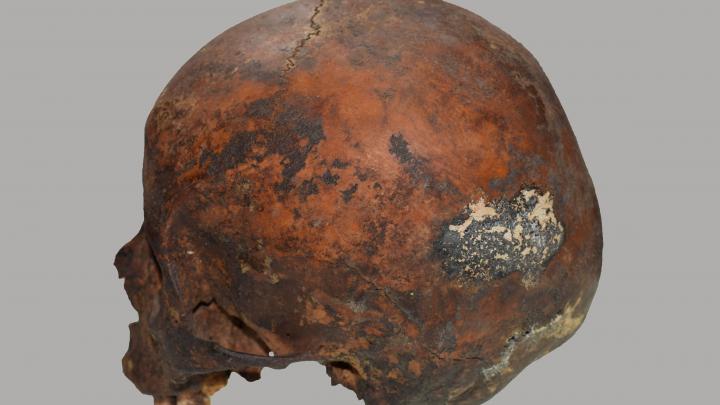
Skull of a boy from Ampato volcano, burned by lightning
[Credit: D. Socha]
Archaeologists know a dozen places in Peru, where about 500 years ago, on the tops of mountains or volcanoes, the Incas sacrificed children in the capacocha ritual. Dagmara Socha, a bioarchaeologist from the Center for Andean Studies of the University of Warsaw (CEAC) in Cuzco, has been studying these remains for several years as part of a project carried out jointly with Rudi Chavez Perea. He is the director of the Museo Santuarios Andinos of the Catholic University of Santa Maria in Arequipa (Peru).

This year, researchers focused on the remains of children laid on the tops of two volcanoes - Ampato and Pitchu Pitchu. Several decades ago, Dr. Johan Reihard found these remains, seated in stone platforms that looked like rectangular squares. They are currently kept in cold storage at Museo Sancturios Andinos. Some are very well preserved in the form of mummies.


According to Socha, the Incas believed that at the time of sacrifice the children would become intermediaries between gods and people. "The Incas considered the children pure and untouched; their status was supposed to facilitate persuading the gods to make specific decisions" - explains Socha.

Scientists still do not know what was the key to selecting children who were sacrificed. "They certainly had to have some exceptional traits, such as beauty or ancestry" - says Socha. In the case of one of the girls whose remains were found in a platform on Pichu Pichu, researchers noticed deliberate deformation of the head, which was elongated. It is known that this practice was used not in the mountains, but rather in the lowland, coastal part of the Inca empire. This may mean - the researcher suggests - that the girl was taken from a family living in a very distant region.

Inca child sacrifice victims came from all over the empire
Children offered in a sacrifice ritual by the pre-Columbian culture Chimú
[Credit: Programa Arqueologico Huanchaco/AFP]
There is another argument to support this theory. On the girl`s teeth there are visible changes in the enamel structure, in the form of a line clearly distinguished from the rest of the teeth. Such traces occur in people who experienced hunger at some point in their lives. They can also form as a result of other reasons disrupting their development, for example very strong stress. In the case of the examined remains of the girl, it is known that this occurred around the age of three.

"I suppose it was then that the girl was taken away from her parents and brought to Cuzco, the capital of the Inca empire, where girl was being prepared for three years to be sacrificed at the top of the volcano" - says Socha.


Some of the remains of six children examined by Socha this year were mummified. But not all of them. Some remains are poorly preserved, and some have burn marks. Socha explains that the Incas erected sacrificial platforms in places exposed to lightning strikes. There are many indications that lightning would strike the platforms repeatedly. That is why soft tissues and clothes that children were wearing at the time of death have not survived to our times.

"According to the Incas, a person struck by lightning received great honour: a god expressed interest in that person" - she adds.

Inca child sacrifice victims came from all over the empire
Skull of a child sacrifice at Huanchaquito-Las Llamas in Peru
[Credit: © John Verano]
The concept of lightning strike is also supported by the fact that the soil around the remains was crystallized.

The mummies examined by Socha are now frozen (kept in a similar condition as at the time of discovery). Research did not involve unwrapping mummies - quite the opposite. Scientists strive to minimize interference in the remains. To determine their content, they used X-rays (radiography). Thanks to this, we know about numerous objects in the mummies: metal objects, including gold pins fastening robes, but also wooden ones, ritual cups. There were also other decorations, for example a gold tube or petals. Socha says that very similar objects are found at mummies discovered in Argentina. This means that the set of objects deposited with children was similar throughout the great Inca empire.

Photogrammetry and 3D modelling specialists Dominika Sieczkowska (CEAC UW) and Bartosz Chmielewski (Wroclaw University of Science and Technology) created a three-dimensional photogrammetric model of mummy.

"The remains of children, including mummies, were taken out of refrigerators for a maximum of twenty minutes, after which they were returned to the cold storage. Thanks to the models, we can now make analyses in the comfort of the office" - she adds.

Next year, scientists plan to continue studying the remains of children. Taking tooth samples will allow to determine their diet and place of origin. This year`s work was financed by the Peruvian side.

Author: Szymon Zdzieblowski | Source: PAP - Science in Poland [September 30, 2019]

Machu Picchu: Ancient Incan sanctuary intentionally built on faults


The ancient Incan sanctuary of Machu Picchu is considered one of humanity's greatest architectural achievements. Built in a remote Andean setting atop a narrow ridge high above a precipitous river canyon, the site is renowned for its perfect integration with the spectacular landscape. But the sanctuary's location has long puzzled scientists: Why did the Incas build their masterpiece in such an inaccessible place? Research suggests the answer may be related to the geological faults that lie beneath the site.

Machu Picchu: Ancient Incan sanctuary intentionally built on faults
Detailed mapping indicates the World Heritage Site's location and layout were dictated
by the underlying geological faults [Credit: Rualdo Menegat]
On Monday, 23 Sept. 2019, at the GSA Annual meeting in Phoenix, Rualdo Menegat, a geologist at Brazil's Federal University of Rio Grande do Sul, presented the results of a detailed geoarchaeological analysis that suggests the Incas intentionally built Machu Picchu -- as well as some of their cities -- in locations where tectonic faults meet. "Machu Pichu's location is not a coincidence," says Menegat. "It would be impossible to build such a site in the high mountains if the substrate was not fractured."


Using a combination of satellite imagery and field measurements, Menegat mapped a dense web of intersecting fractures and faults beneath the UNESCO World Heritage Site. His analysis indicates these features vary widely in scale, from tiny fractures visible in individual stones to major, 175-kilometer-long lineaments that control the orientation of some of the region's river valleys.

Menegat found that these faults and fractures occur in several sets, some of which correspond to the major fault zones responsible for uplifting the Central Andes Mountains during the past eight million years. Because some of these faults are oriented northeast-southwest and others trend northwest-southeast, they collectively create an "X" shape where they intersect beneath Machu Picchu.

Machu Picchu: Ancient Incan sanctuary intentionally built on faults
The Incas took advantage of pre-existing fractures in local stones to reduce the amount of energy
needed to create their master stonework [Credit: Terri Cook and Lon Abbott]
Menegat's mapping suggests that the sanctuary's urban sectors and the surrounding agricultural fields, as well as individual buildings and stairs, are all oriented along the trends of these major faults. "The layout clearly reflects the fracture matrix underlying the site," says Menegat. Other ancient Incan cities, including Ollantaytambo, Pisac, and Cusco, are also located at the intersection of faults, says Menegat. "Each is precisely the expression of the main directions of the site's geological faults."


Menegat's results indicate the underlying fault-and-fracture network is as integral to Machu Picchu's construction as its legendary stonework. This mortar-free masonry features stones so perfectly fitted together that it's impossible to slide a credit card between them. As master stoneworkers, the Incas took advantage of the abundant building materials in the fault zone, says Menegat. "The intense fracturing there predisposed the rocks to breaking along these same planes of weakness, which greatly reduced the energy needed to carve them."

In addition to helping shape individual stones, the fault network at Machu Picchu likely offered the Incas other advantages, according to Menegat. Chief among these was a ready source of water. "The area's tectonic faults channeled meltwater and rainwater straight to the site," he says. Construction of the sanctuary in such a high perch also had the benefit of isolating the site from avalanches and landslides, all-too-common hazards in this alpine environment, Menegat explains.

Machu Picchu: Ancient Incan sanctuary intentionally built on faults
Natural block in Machu Picchu Mountain. The local network of faults and fractures is visible
in the blocks of rock integrated into Machu Picchu's structures [Credit: Rualdo Menegat]
The faults and fractures underlying Machu Picchu also helped drain the site during the intense rainstorms prevalent in the region. "About two-thirds of the effort to build the sanctuary involved constructing subsurface drainages," says Menegat. "The preexisting fractures aided this process and help account for its remarkable preservation," he says. "Machu Picchu clearly shows us that the Incan civilization was an empire of fractured rocks."

Source: Geological Society of America [September 23, 2019]

Peruvian archaeologists find exotic feather headdress in Pampa La Cruz


On the last day of excavations in the archaeological zone of Pampa La Cruz, archaeologist Gabriel Prieto and his research team found the remains of a new Chimu individual buried with luxury clothes —made of exotic bird feathers— over his head and body.

Peruvian archaeologists find exotic feather headdress in Pampa La Cruz
Credit: Andina
Prieto is the head of the Huanchaco Archaeological Project and leads excavations in Pampa La Cruz, an area located in the beachside town of Huanchaco in northern Trujillo province (La Libertad region).


He told Andina news agency that the body was covered by a tabard —similar to what we know nowadays as a poncho— which measures around 1.10 m in length and is made of red and yellow feathers, but whose conservation status is not the desired one.

They also found a very bright and colorful headdress carefully made of blue, white, green, black, and yellow feathers.

Peruvian archaeologists find exotic feather headdress in Pampa La Cruz
Credit: Andina


Peruvian archaeologists find exotic feather headdress in Pampa La Cruz
Credit: Andina
"We need to conduct studies to identify the type of birds from which such feathers were taken and the manufacturing technique, and because we think a black resin —a popular product in the country's rainforest nowadays— was used to secure the threads and ropes of the headdress," he noted.


The researcher explained that the squatting position —in which the skeleton was found— is similar to the one seen in the previous excavation season, when a feather headdress and tabard were found as well.

Nevertheless, he noted that one of the few differences between both findings is that the blue color prevails in the first one, while yellow, red, white, and black stand out in the recent one.

Archaeologists find remains of 227 sacrificed children in Peru


Archaeologists in Peru say the 227 bodies they have unearthed from a site used by the pre-Columbian Chimu culture is the biggest-ever discovery of sacrificed children.

Archaeologists find remains of 227 sacrificed children in Peru
Sacrificed remains in Pampa la Cruz neighbourhood of Huanchaco
[Credit: Programa Arqueologico Huanchaco]
Archaeologists have been digging since last year at the huge sacrificial site in Huanchaco, a beachside tourist town north of the capital Lima.


"This is the biggest site where the remains of sacrificed children have been found," chief archaeologist Feren Castillo told AFP on Tuesday.

Archaeologists find remains of 227 sacrificed children in Peru
Textile and feather headdress detail [Credit: Programa Arqueologico Huanchaco]
Castillo said the children, who were aged between four and 14, were sacrificed in a ritual to honor the Chimu culture's gods.

"They were sacrificed to appease the El Nino phenomenon," and show signs of being killed during wet weather, he said.

Archaeologists find remains of 227 sacrificed children in Peru
Two of the sacrificed children [Credit: Programa Arqueologico Huanchaco]
He added that there may still be more to be found.


"It's uncontrollable, this thing with the children. Wherever you dig, there's another one," Castillo said.

Archaeologists find remains of 227 sacrificed children in Peru
Remains of child with textiles [Credit: Programa Arqueologico Huanchaco]
The children's remains were found in a position facing the sea. Some still had skin and hair.

Huanchaco was a site where many child sacrifices took place during the time of the Chimu culture, whose apogee was between 1200 and 1400.

Archaeologists find remains of 227 sacrificed children in Peru
Child buried with grave goods [Credit: Programa Arqueologico Huanchaco]
Archaeologists first found children's bodies at the dig site in the town's Pampa la Cruz neighbourhood in June 2018, unearthing 56 skeletons.


Pampa la Cruz is a short distance from Huanchaquito, where the remains of 140 sacrificed children and 200 llamas were found in April 2018.


The Chimu civilization extended along the Peruvian coast to Ecuador but disappeared in 1475 after it was conquered by the Inca empire.

Source: AFP [August 28, 2019]

3,800-year-old relief discovered in Peru


A relief thought to be 3,800 years old has been revealed by archaeologists in Peru. The wall, unveiled on Monday, was found inside a public ceremonial building at the Vichama site, north of Lima.

3,800-year-old relief discovered in Peru
Credit: Zona Arqueológica Caral
The complex carved scene depicts iconography including a human-like toad and representations of people.

Dr Ruth Shady Solís, director of the Caral Archaeological Zone (ZAC), believes the scene represents the "arrival of water" through rainfall.


She says that in Andean civilisation, toads represented water and says the face below it represents humans waiting for rainfall to give continuity of life.

Another depiction found nearby shows four human heads with snakes encircling them and what appears to be a seed with a face.

Researchers said the sculptures would probably have been produced in a period of scarcity and famine.

Student’s find in Peru offers lesson in how archaeologists piece together stories of a people


Caroline Coolidge was stunned. The rising second-year was digging at the archaeology field school in San José de Moro, Peru, and there in the dusty dirt a small face stared up at her. She thought her eyes were playing tricks on her.

Student’s find in Peru offers lesson in how archaeologists piece together stories of a people
Caroline Coolidge at the excavation site [Credit: Harvard Gazette]
"I honestly at first just thought I was imagining it because I just wanted to find something so bad," said Coolidge, a Leverett House resident who is taking part in the summer archaeology program run by Pontifícia Universidad Católica del Perú in collaboration with the Harvard Summer School Study Abroad Program. "I thought, "This can't be this intact piece of pottery." But I just kept brushing away. I was honestly speechless when I saw what it was."

It turned out to be truly special.

Earlier in the week students had unearthed fragments of ceramic vessels, a typical find at one of the oldest ceremonial burial grounds for the Moche, a pre-Columbian civilization that flourished along Peru's northern coast between the first and eighth century A.D. But Coolidge had come up empty. "I hadn't really found anything where I had been working," she said. "I was excited but feeling a little bit discouraged because I wondered if I was doing this wrong."


Determined, she kept at it, using her trowel to methodically clear away dirt in the site's northwest corner. Then, as she brushed the dried soil from what she thought was a rock, she slowly uncovered a fully intact figurine, likely from the transitional period between the Moche and Lambayeque cultures and approximately 1,000 years old. In addition to its pristine condition, what made Coolidge's discovery so unusual was the absence of other objects nearby. "Typically, this type of artifact would be included in a burial," she said, "but there were no burials found near it."

Student’s find in Peru offers lesson in how archaeologists piece together stories of a people
Caroline Coolidge displays the figurine she unearthed at the archaeology site in Peru
[Credit: Harvard Gazette]
Studying the cultural heritage of some of Peru's earliest civilizations is at the heart of the field school run by Luis Jaime Castillo Butters, a visiting professor at Harvard in 2016 and professor of archaeology at Pontifícia Universidad Católica, who was recently named Peru's minister of culture, and by Gary Urton, Harvard's Dumbarton Oaks Professor of Pre-Columbian Studies. During the five-week program participants visit Peruvian archaeological sites and museums and learn the fundamentals of archaeological documentation and analysis. They also learn how to excavate, uncovering funerary relics and other items that point to how groups such as the Moche celebrated life and death, and how and why they flourished or failed.

"We are trying to understand another culture by looking at their material remains," said Urton, whose research focuses on pre-Columbian and early colonial Andean cultural and intellectual history. "All of these Peruvian civilizations did not have writing so we don't have their own words … what we do have is what they lived with, what they made, what they used in their day-to-day lives. So what we try to do then with the students is have this balance between the real physical excitement of working in the field and the intellectual challenge of thinking about what it all means."


Coolidge is eager to find out more about what her figurine might mean—archaeologists at the site suspect it may have been used as a fertility offering. Urton called it "an extraordinary piece" and "one of the most complete and beautiful figurines we have brought up from here in several years." Coolidge plans to write about the artifact for her final class project and will study its composition and compare it with similar finds at the site in recent years, she said, to determine "its cultural significance and where it fits within the region's chronology."

On a Skype call after a long day of digging, Coolidge said the experience had helped her hone her academic focus. She said she intends to either concentrate in archaeology or make it a secondary field of study during her time at Harvard.

"I knew it was going to be amazing," she said. "But I didn't realize it was going to be this amazing."

Author: Colleen Walsh | Source: Harvard University [July 30, 2019]