Theme images by kelvinjay. Powered by Blogger.

USA

AFRICA

ASIA

Brazil

Portugal

United Kingdom

Switzerland

Cave lion figurine made of mammoth tusk found at Denisova Cave


A fragment of a cave lion figurine estimated to be 45,000 years old was unearthed in Siberia’s Denisova Cave by researchers led by Mikhail Shunkov of the Novosibirsk Institute of Archaeology and Ethnography.

Cave lion figurine made of mammoth tusk found at Denisova Cave
Credit: Novosibirsk Institute of Archaeology and Ethnography
The precious small - 42mm long, 8mm thick and 11mm high - figurine of a cave lion (Panthera spelaea, lat) was made by an Upper Palaeolithic artist between 40,000 and 45,000 years ago. It was found inside the 11th layer of the southern gallery of the Denisova Cave.


This is the oldest sculptural zoomorphic image ever found in Siberia and throughout the territory of Northern and Central Asia.

The precise age is yet to be confirmed, but the cautious dating given by Siberian archaeologists means that this might be the oldest animal figurine in the world.


The lion’s head is missing, what we see is its hind legs, groin, back and belly, covered in an ornament of eighteen rows of nothes. There are two extra rows with four notches on the lion’s right side.


‘The figurine depicts an animal with its tummy tucked in, its hind legs bent. It is either galloping, jumping or getting ready to jump. The animal is shown in a typical for big cats position for the moment when they are ready to catch a prey’, said Mikhail Shunkov, head of the Institute’s Stone Age Archaeology Department.

The mammoth ivory for the statuette was delivered from quite a distance away, Russian scientists say. It had to be carried for at least 100 kilometres from the northern footsteps of the Altai Mountains.

Cave lion figurine made of mammoth tusk found at Denisova Cave
Credit: Novosibirsk Institute of Archaeology and Ethnography
After finishing the figurine, the cave artist used red ochre to paint it.

So far traces of it were found mostly around the stomach area - which even led to an idea that it could be symbolising a bleeding wound - but researcher Alexander Fedorchenko believes that most likely the whole animal was painted red.

Remains of ocher were found only in the southern gallery of the Denisova cave.

Authors: Anna Liesowska & Svetlana Skarbo | Source: The Siberian Times [November 20, 2019]

Inequality: What we've learned from the 'Robots of the late Neolithic'


Seven thousand years ago, societies across Eurasia began to show signs of lasting divisions between haves and have-nots. In new research published in the journal Antiquity, scientists chart the precipitous surge of prehistoric inequality and trace its economic origins back to the adoption of ox-drawn ploughs.

Inequality: What we've learned from the 'Robots of the late Neolithic'
A Canadienne ox at a historic village in New Brunswick, Canada
[Credit: Amy Bogaard]
Their findings challenge a long-held view that inequality arose when human societies first transitioned from hunting and gathering to agriculture. According to the researchers, it was not agriculture per se that ushered in substantial wealth inequalities, but instead a transformation of farming that made land more valuable and labour less so.

"Ox drawn ploughs were the robots of the late Neolithic," explains co-author Samuel Bowles, an economist at the Santa Fe Institute. The oxen were a form of labour-saving technology that led to a decoupling of wealth from labour - a decoupling fundamental to modern wealth inequality. "The effect was the same as today: growing economic disparities between those who owned the robots and those whose work the robots displaced."

In the first of two companion papers, the researchers present new statistical methods for comparing wealth inequality across different kinds of wealth, different societies, in different regions, at different times in history. Their analysis of data from 150 archaeological sites reveals a steep increase in inequality in Eurasia from around 4,000 BC -- several millennia after the advent of agriculture.


"The surprise here isn't so much that inequality takes off later on, it's that it stayed low for such a long time," says lead author Amy Bogaard, an archaeologist based at the University of Oxford who is also an external professor at the Santa Fe Institute.

"The usual story -- that the societies that adopted agriculture became more unequal -- is no longer valid because we observed that some societies who adopted agriculture were remarkably egalitarian for thousands of years," says co-author Mattia Fochesato, an economist at Bocconi University.

Before around 4,000 BC, societies across the Middle East and Europe cultivated a patchwork of small garden plots, which Bogaard likens to present-day "allotments" in the UK. Families would have grown a variety cereal grains, as well as lentils, peas, and other pulse crops that needed to be harvested by hand. Notably, they would have tilled the soil by hand using hoes, in some cases also with the help of unspecialized cattle (such as aging milk cows) to pull ploughs, and carefully monitored their gardens during the growing season to protect them from wild animals. "It was quite a busy landscape, with lots of people working in and around these garden plots."

Inequality: What we've learned from the 'Robots of the late Neolithic'
Humble ox or Neolithic robot? [Credit: Amy Bogaard]
Then something changed. Farmers who were well resourced enough to raise and maintain specialized plough oxen saw new opportunities in farming additional land. A single farmer with an ox team could cultivate ten times or more land than a hoe farmer, and would begin to acquire more and more land to cultivate. Those who owned land and ox teams also began to opt for more stress-tolerant crops, like barley or certain kinds of wheat, that didn't require much labour.

By the second millennium BC in many farming landscapes fields stretched to the horizon, and societies were deeply divided between wealthy landowners, who passed their holdings on to their children, and land-poor or landless families.

The mechanism that drove this change is detailed in an economic model in the researchers' second paper. It reveals a key distinction between farming systems where human labour was the limiting factor for production, versus systems where human labour was more expendable, and where land was the limiting factor.


"So long as labour was the key input for production, inequality was limited because families did not differ much in how much labor they could deploy to produce crops, " Fochesato explains. "But when the most important input became land, differences between families widened because land and other material forms of wealth could be accumulated and transmitted over generations. By chance, or force, or hard work, some families came to have a lot more than others. Then radical inequality arose."

The two new papers are part of a growing body of scientific research that is applying comparative economic measures to the archaeological record. Much of the work is part of Bowles' long-running series of interdisciplinary workshops on the origins of wealth inequality, which convene annually at the Santa Fe Institute. The new research supports previous findings by archaeologist Tim Kohler et al (Nature, 2017), which drew attention to a markedly greater wealth inequality in post-Neolithic Eurasia than in the Americas, where domesticated draft animals would not have been available.

One consequence of inequality, Bogaard notes, is that the most unequal societies tended to be more fragile and susceptible to political upheaval or climate change.

The takeaway for people today is that "if there are opportunities to monopolize land or other key assets in a production system, people will. And if there aren't institutional or other redistributive mechanisms, inequality is always where we're going to end up." Land is still a relevant asset, Bogaard says, "but there are many other kinds of assets now that we should think about people's capacity to own and benefit from."

Author: Jenna Marshall | Source: Santa Fe Institute [September 18, 2019]

'Game-changing' research could solve evolution mysteries


An evolution revolution has begun after scientists extracted genetic information from a 1.7 million-year-old rhino tooth - the largest and oldest genetic data to ever be recorded.

'Game-changing' research could solve evolution mysteries
A Stephanorhinus skull from Dmanisi [Credit: Mirian Kiladze, 
Georgian National Museum]
Researchers identified an almost complete set of proteins, a proteome, in the dental enamel of the rhino and the genetic information discovered is one million years older than the oldest DNA sequenced from a 700,000-year-old horse.

The findings by scientists from the University of Copenhagen and St John's College, University of Cambridge, are published in Nature. They mark a breakthrough in the field of ancient biomolecular studies and could solve some of the biggest mysteries of animal and human biology by allowing scientists to accurately reconstruct evolution from further back in time than ever before.

Professor Enrico Cappellini, a specialist in Palaeoproteomics at the Globe Institute, University of Copenhagen, and first author on the paper, said: "For 20 years ancient DNA has been used to address questions about the evolution of extinct species, adaptation and human migration but it has limitations. Now for the first time we have retrieved ancient genetic information which allows us to reconstruct molecular evolution way beyond the usual time limit of DNA preservation. This new analysis of ancient proteins from dental enamel will start an exciting new chapter in the study of molecular evolution."


DNA data that genetically tracks human evolution only covers the last 400,000 years. But the lineages that led to modern humans and to the chimp - the living species genetically closest to humans - branched apart around six to seven million years ago which means scientists currently have no genetic information for more than 90 per cent of the evolutionary path that led to modern humans.

Scientists also don't know what the genetic links are between us and extinct species such as Homo erectus - the oldest known species of human to have had modern human-like body proportions - because everything that is currently known is almost exclusively based on anatomical information, not genetic information.

Researchers have now used ancient protein sequencing - based on ground-breaking technology called mass spectrometry - to retrieve genetic information from the tooth of a 1.77 million year old Stephanorhinus - an extinct rhinoceros which lived in Eurasia during the Pleistocene. Researchers took samples of dental enamel from the ancient fossil which was discovered in Dmanisi, Georgia, and used mass spectrometry to sequence the ancient protein and retrieved genetic information previously unobtainable using DNA testing.

'Game-changing' research could solve evolution mysteries
Left lower Stephanorhinus molar from Dmanisi 
[Credit: Natural History Museum of Denmark]
Tooth enamel is the hardest material present in mammals. In this study researchers discovered the set of proteins it contains lasts longer than DNA and is more genetically informative than collagen, the only other protein so far retrieved from fossils older than one million years.

Professor Jesper V. Olsen, head of the Mass Spectrometry for Quantitative Proteomics Group at the Novo Nordisk Foundation Center for Protein Research, University of Copenhagen, and co-corresponding author on the paper, said: "Mass spectrometry-based protein sequencing will enable us to retrieve reliable and rich genetic information from mammal fossils that are millions of years old, rather than just thousands of years old. It is the only technology able to provide the robustness and accuracy needed to sequence tiny amounts of protein this old."

Professor Cappellini added: "Dental enamel is extremely abundant and it is incredibly durable, which is why a high proportion of fossil records are teeth.


"We have been able to find a way to retrieve genetic information that is more informative and older than any other source before, and it's from a source that is abundant in the fossil records so the potential of the application of this approach is extensive."

Lead author on the paper Professor Eske Willerslev, who holds positions at St John's College, University of Cambridge, and is director of The Lundbeck Foundation Centre for GeoGenetics, Globe Institute, Faculty of Health and Medical Sciences, at the University of Copenhagen, said: "This research is a game-changer that opens up a lot of options for further evolutionary study in terms of humans as well as mammals. It will revolutionise the methods of investigating evolution based on molecular markers and it will open a complete new field of ancient biomolecular studies."

This rearranging of the evolutionary lineage of a single species may seem like a small adjustment but identifying changes in numerous extinct mammals and humans could lead to massive shifts in our understanding of the way the world has evolved.

The team of scientists is already implementing the findings in their current research. The discovery could enable scientists across the globe to collect the genetic data of ancient fossils and to build a bigger, more accurate picture of the evolution of hundreds of species including our own.

Source: University of Cambridge [September 11, 2019]

Iron Age grave of Xiongnu woman wearing huge black gemstone belt buckle found in Siberia


An extraordinary 2,137-year-old belt buckle been dug from a grave of a young woman who lived before the birth of Christ.

Bronze Age grave of Xiongnu woman wearing huge black gemstone belt buckle found in Siberia
AT1/29 burial with jet belt buckle [Credit: Institute for the History
of Material Culture, Russian Academy of Sciences]
The ancient fashionista, nicknamed Natasha by archaeologists, was found with a black rectangular accessory worn as a belt buckle.


Her grave was discovered during the draining of a vast man-made reservoir in the mountainous Republic of Tuva, Siberia, which stretches across 240 square miles.

The ancient necropolis is described as 'The Russian Atlantis' for it is usually submerged under 56ft of water before being drained for a few weeks every year.

Bronze Age grave of Xiongnu woman wearing huge black gemstone belt buckle found in Siberia
Detail of jet buckle with semiprecious stone inlay [Credit: Institute for the History
of Material Culture, Russian Academy of Sciences]
Bronze Age grave of Xiongnu woman wearing huge black gemstone belt buckle found in Siberia
Chinese wuzhu coin that adorned the belt of the woman in AT1/29 [Credit: Institute for the History
of Material Culture, Russian Academy of Sciences]
Bronze Age grave of Xiongnu woman wearing huge black gemstone belt buckle found in Siberia
The find was made in 2016 at the Ala-Tey necropolis in the Sayan Sea [Credit: Institute for the History
of Material Culture, Russian Academy of Sciences]
The giant reservoir known as the Ala-Tey necropolis in the so-called Sayan Sea is upstream of the Sayano-Shushenskaya Dam, Russia's biggest power plant. The region is also a favourite vacation spot for Vladimir Putin.


The mobile lookalike is made of black gemstone jet, a type of lignite, with inlays of semi-precious stones. It measures 7 inches by 3.5 inches and is inlaid with decorations of turquoise, carnelian and mother-of-pearl.

Bronze Age grave of Xiongnu woman wearing huge black gemstone belt buckle found in Siberia
Burial AT1-86 with jet decorated belt [Credit: Institute for the History
of Material Culture, Russian Academy of Sciences]
Bronze Age grave of Xiongnu woman wearing huge black gemstone belt buckle found in Siberia
Jet buckle from AT1-86 engraved with mountain goats [Credit: Institute for the History
of Material Culture, Russian Academy of Sciences]
Bronze Age grave of Xiongnu woman wearing huge black gemstone belt buckle found in Siberia
Openwork bronze belt buckle horses in combat from grave AT1/42 [Credit: Institute for the History
of Material Culture, Russian Academy of Sciences]
Bronze Age grave of Xiongnu woman wearing huge black gemstone belt buckle found in Siberia
Bronze belt buckle depicting horses in combat from grave AT1/42 [Credit: Institute for the History
of Material Culture, Russian Academy of Sciences]
Bronze Age grave of Xiongnu woman wearing huge black gemstone belt buckle found in Siberia
The so-called 'Sleeping beauty' in silk clothes found at the site [Credit: Institute for the History
of Material Culture, Russian Academy of Sciences]
Archaeologist Dr Pavel Leus said: 'Natasha's' burial with a Hunnu-era (Xiongnu) iPhone remains one of the most interesting at this burial site.' 


'Hers was the only belt decorated with Chinese wuzhu coins which helped us to date it,' said the academic. 

Graves of prehistoric civilisations dating from the Bronze Age to the time of Genghis Khan are located at the reservoir.

Bronze Age grave of Xiongnu woman wearing huge black gemstone belt buckle found in Siberia
Ala-Tay mountain in early June after the run-off [Credit: Institute for the History
of Material Culture, Russian Academy of Sciences]
Bronze Age grave of Xiongnu woman wearing huge black gemstone belt buckle found in Siberia
Ala-Tay mountain at the end of June after the reservoir is refilled [Credit: Institute for the History
of Material Culture, Russian Academy of Sciences]
Previous findings include two partly-mummified prehistoric fashionistas buried with the tools of their trade.


One was called 'Sleeping Beauty' because she was dressed in silk for the afterlife and was at first believed to be a priestess. However the woman is now thought to have been a leather designer. The second was a weaver laid to rest with her wooden spindle packed inside a sewing bag.

A total of 110 burials appeared on an island in the reservoir at Ala-Tey site.


Leader of the expedition Dr Marina Kilunovskaya from the St Petersburg Institute of Material History Culture described the Ala-Tey site as 'a scientific sensation'.

Dr Kilunovskaya added: 'We are incredibly lucky to have found these burials of rich Hun nomads that were not disturbed by [ancient] grave robbers.'

Another Atlantis site called Terezin has at least 32 graves and is closer to the shore.

Scientists admit they are in a race against time to examine the sites and save priceless treasures from damage by water.

Author: Will Stewart | Source: Daily Mail Online [September 09, 2019]

Neolithic pile house discovered in North-Western Russia


In July and August, the North-Western archaeological expedition, with the support of the student archaeological group 'Chronos', conducted both surface and underwater surveys to locate possible Stone Age settlements in the valley of the Serteika River in the north of the Smolensk region.

Neolithic pile house discovered in North-Western Russia
Credit: Fontanka
During the course of the research, archaeologists discovered the remains of the wooden pile house of the fifth millennium BC buried in the river's mud and numerous architectural details were recorded.


Oars and fragments of oars, wooden utensils, bone and flint tools, as well as numerous pottery fragments were found in and around the house. The most striking of these is a cup with depicting a snake.

Neolithic pile house discovered in North-Western Russia
Add caption
Neolithic pile house discovered in North-Western Russia
Add caption
Neolithic pile house discovered in North-Western Russia
Credit: Fontanka


Neolithic pile house discovered in North-Western Russia
Add caption
Neolithic pile house discovered in North-Western Russia
Add caption
Neolithic pile house discovered in North-Western Russia
Credit: Fontanka


"Among the finds made during the excavations of the pile house, a special place is occupied by amber ornaments, which were made by craftsmen in the southeastern Baltic region and which reached the territory of today's Smolensk region, probably as a result of trade", explains Andrey Mazurkevich, the expedition chief, and senior researcher of the Department of Archaeology of Eastern Europe and Siberia of the State Hermitage Museum.

A settlement believed to date to the third millennium BC was also identified along the banks of the river.

Source: Fontanka [trsl. TANN, August 17, 2019]

Archaeologists find evidence of Neanderthal habitation in Georgian cave


Archaeologists have reported identifying and unearthing artifacts of neanderthal habitation sites dated back 50,000 years at the Tsutskhvati Cave Natural Monument in Georgia's west and hope to find answers to their extinction.

Archaeologists find evidence of Neanderthal habitation in Georgian cave
Excavation in Tsutskhvati Cave [Credit: National Museum of Georgia]
In two separate findings, scientists identified a previously discovered item from the site as belonging to a neanderthal-era campsite while also unearthing traces of homo sapiens at the location.

A child's tooth found at Tsutskhvati in previous digs has now been confirmed to be dated back to around 50,000 years ago, confirming its connections to the Upper Palaeolithic period.


Additionally, a new finding of signs of Homo sapiens from the same era has been assigned to the period between 80,000-12,000 years ago.

The archaeologists involved in the digs reported the discovery would enable the Tsutskhvati expedition, led by Nikoloz Tsikaridze, to conduct a "detailed study of neanderthals".

A release by the Georgian National Museum said the earliest residents' "behaviour, relation to the modern human and prospect of mutual connection" would be the questions studied by the team that would "also attempt to find answers to reasons for the extinction of the neanderthals".

Archaeologists find evidence of Neanderthal habitation in Georgian cave
The latest archaeological expedition at the site has been ongoing since 2017
[Credit: National Museum of Georgia]
The scientists also excavated a Chalcolithic settlement in a Tsutskhvati site dubbed The Bronze Cave, indicating remains from an era of early metallurgy.

Located 25km outside regional capital Kutaisi, the site of archaeological works is also part of the protected areas of Georgia.

The caves have been under archaeological investigation since the 1970s, when the State Museum of History of Georgia and the Institute of Palaeobiology carried out joint works at the site.


Their findings included stone tools from 400,000-40,000 years ago and the tooth identified in later examination. The location also saw digs in the late 1990s and the early 2000s, however most of the cave area was only studied starting in 2016.

The current works were launched in 2017 by an international expedition with support of the Shota Rustaveli National Science Foundation, under the project titled 'Neanderthals in the South Caucasus'.

Beside Georgian professionals, the archaeologists involved in the work include scientists from France and the United States, as well as up to 50 local students.

Source: Agenda [August 09, 2019]

Out of Africa and into an archaic human melting pot


Genetic analysis has revealed that the ancestors of modern humans interbred with at least five different archaic human groups as they moved out of Africa and across Eurasia.

Out of Africa and into an archaic human melting pot
A map showing where the ancestors of modern humans appear to have met and mixed
with archaic hominins [Credit: University of Adelaide]
While two of the archaic groups are currently known - the Neanderthals and their sister group the Denisovans from Asia ¬- the others remain unnamed and have only been detected as traces of DNA surviving in different modern populations. Island Southeast Asia appears to have been a particular hotbed of diversity.

Published in the Proceedings of the National Academy of Sciences, researchers from the University of Adelaide's Australian Centre for Ancient DNA (ACAD) have mapped the location of past "mixing events" (analysed from existing scientific literature) by contrasting the levels of archaic ancestry in the genomes of present-day populations around the world.


"Each of us carry within ourselves the genetic traces of these past mixing events," says first author Dr João Teixeira, Australian Research Council Research Associate, ACAD, at the University of Adelaide. "These archaic groups were widespread and genetically diverse, and they survive in each of us. Their story is an integral part of how we came to be.

"For example, all present-day populations show about 2% of Neanderthal ancestry which means that Neanderthal mixing with the ancestors of modern humans occurred soon after they left Africa, probably around 50,000 to 55,000 years ago somewhere in the Middle East."

But as the ancestors of modern humans travelled further east they met and mixed with at least four other groups of archaic humans.

Out of Africa and into an archaic human melting pot
Proposed route of the ancestors of modern humans out of Africa and through Island Southeast Asia
[Credit: University of Adelaide]
"Island Southeast Asia was already a crowded place when what we call modern humans first reached the region just before 50,000 years ago," says Dr Teixeira. "At least three other archaic human groups appear to have occupied the area, and the ancestors of modern humans mixed with them before the archaic humans became extinct."

Using additional information from reconstructed migration routes and fossil vegetation records, the researchers have proposed there was a mixing event in the vicinity of southern Asia between the modern humans and a group they have named "Extinct Hominin 1".


Other interbreeding occurred with groups in East Asia, in the Philippines, the Sunda shelf (the continental shelf that used to connect Java, Borneo and Sumatra to mainland East Asia), and possibly near Flores in Indonesia, with another group they have named "Extinct Hominin 2".

"We knew the story out of Africa wasn't a simple one, but it seems to be far more complex than we have contemplated," says Dr Teixeira. "The Island Southeast Asia region was clearly occupied by several archaic human groups, probably living in relative isolation from each other for hundreds of thousands of years before the ancestors of modern humans arrived.

"The timing also makes it look like the arrival of modern humans was followed quickly by the demise of the archaic human groups in each area."

Author: Robyn Mills | Source: University of Adelaide [July 15, 2019]

Receding waters of made-made lake in Siberia reveal ancient burial ground


Unique necropoli in remote republic of Tuva with more than one hundred undisturbed burials from the Bronze era to the time of Genghis Khan appear eerily from under the water only once a year. The precious archaeological site is located at the bottom of the so-called Sayan Sea, an artificial reservoir created upstream of the Sayano-Shushenskaya Dam, Russia’s biggest power plant.

Receding waters of made-made lake in Siberia reveal ancient burial ground
The archaeological site is located at the bottom of the so-called Sayan Sea
[Credit: RGO/The Siberian Times
]
Scientists can only work here from mid-May to the end of June, with water daily destroying burials made at sea shores, and threatening graves hidden on the reservoir bed. Last year a 2,000-year-old mummified ‘sleeping beauty’ dressed in silk emerged from one of the stone graves.


In this case, the artificial sea - which one day will wipe all traces of this ancient site altogether - has worked as a blessing, as it washed off several layers of soil and revealed a rectangle-shaped stone construction with the ‘Sleeping Beauty’ inside it.

Receding waters of made-made lake in Siberia reveal ancient burial ground
Archaeologists are in a 'race against time' to recover treasures
[Credit: RGO/The Siberian Times]
Luckily for archaeologists, the burial had been so well-sealed with a stone lid that first it enabled a process of natural body mummification, and then protected the mummy when the grave was submerged after construction of the dam, on which work started in 1963.

The young woman was laid to rest wearing a silk skirt held by a beaded belt with a precious jet gemstone buckle. There was a rich funeral meal and a pouch of pine nuts prepared for her afterlife, and inside her most intricately-made stylish wooden bag was her Chinese mirror.


Among the young fashionista’s other treasures were turquoise beads used to decorate the belt, a set of much smaller purple beads, fragments of a belt’s ring made of copper alloy and a bone belt buckle with beautiful engraving. There was also an iron knife with a ringed handle.

"This site is a scientific sensation", said Dr Marina Kilunovskaya from the St Petersburg Institute of Material History Culture, who leads the Tuva Archaeological Expedition. "We are incredibly lucky to have found these graves of rich Hun nomads that were not disturbed by robbers. We discovered 110 burials at the Ala-Tey burial site, which is usually 15 metres underwater. Another site which was made at what is now the Sayan Sea shore is getting quickly destroyed by crumbling soil. It is called Terezin, and there we found 32 graves."

Receding waters of made-made lake in Siberia reveal ancient burial ground
A prehistoric 'fashionista' - dressed in silk for the afterlife - has been dubbed
'Sleeping Beauty' [Credit: IHMC RAS/The Siberian Times]
Receding waters of made-made lake in Siberia reveal ancient burial ground
Another view of the 'Sleeping Beauty' [Credit: IHMC RAS/
The Siberian Times]
Receding waters of made-made lake in Siberia reveal ancient burial ground
Rectangular-shaped stone construction in burial 21 with the remains of the ‘Sleeping Beauty’
[Credit: Institute for the History of Material Culture/The Siberian Times]
Receding waters of made-made lake in Siberia reveal ancient burial ground
Some of the wooden artefacts found at the site [Credit: Institute for the History
of Material Culture/The Siberian Times]
Receding waters of made-made lake in Siberia reveal ancient burial ground
Purple beads found in burial 21 [Credit: Sankt-Peterburg TV, Institute for the History
of Material Culture/The Siberian Times]
Receding waters of made-made lake in Siberia reveal ancient burial ground
Charcoal belt buckle found in burial 21 [Credit: Sankt-Peterburg TV, Institute for the History
of Material Culture/The Siberian Times]


Receding waters of made-made lake in Siberia reveal ancient burial ground
Leather bag found in burial 27 [Credit: Sankt-Peterburg TV, Institute for the History
of Material Culture/The Siberian Times]
Receding waters of made-made lake in Siberia reveal ancient burial ground
Wooden comb found in burial 27 [Credit: Sankt-Peterburg TV, Institute for the History
of Material Culture/The Siberian Times]
Receding waters of made-made lake in Siberia reveal ancient burial ground
Bone belt buckle found in burial 27 [Credit: Sankt-Peterburg TV, Institute for the History
of Material Culture/The Siberian Times]
Receding waters of made-made lake in Siberia reveal ancient burial ground
Bronze mirror from the burial 21 [Credit: Institute for the History
of Material Culture/The Siberian Times]
Receding waters of made-made lake in Siberia reveal ancient burial ground
Bronze mirror from the burial 27 [Credit: Institute for the History
of Material Culture/The Siberian Times]
Receding waters of made-made lake in Siberia reveal ancient burial ground
Human remains and grave goods uncovered in Terezin [Credit: Institute for the History
of Material Culture/The Siberian Times]


Receding waters of made-made lake in Siberia reveal ancient burial ground
Human remains showing charcoal belt buckle uncovered in Terezin [Credit: Institute for the History 
of Material Culture/The Siberian Times]
Receding waters of made-made lake in Siberia reveal ancient burial ground
Detail of the charcoal belt buckle uncovered in Terezin [Credit: Institute for the History 
of Material Culture/The Siberian Times]
Receding waters of made-made lake in Siberia reveal ancient burial ground
Charcoal belt buckle found in Terezin [Credit: Institute for the History 
of Material Culture/The Siberian Times]
Receding waters of made-made lake in Siberia reveal ancient burial ground
Human remains showing bronze belt buckle uncovered in Ala-Tei [Credit: Institute for the History 
of Material Culture/The Siberian Times]
Receding waters of made-made lake in Siberia reveal ancient burial ground
Detail of bronze belt buckle uncovered in Ala-Tei [Credit: Institute for the History 
of Material Culture/The Siberian Times]
Russian archaeologists thought that the ‘Sleeping Beauty’ woman must have been a priestess based on how rich was her burial. Further studies of the finds led them to believe that in fact she was an ancient leather designer, buried with her work instruments - several pieces of leather and tendon threads tacked inside a little bag.

Not far from this ‘Sleeping Beauty’, scientists found the mummy of a Hun weaver, with a wooden spindle packed in a leather bag. Preserved in her burial through thousands of years were sparkling glass beads, two stone pendants and two belt buckets made of bone, one with linear and another one with circular patterns, and a birch bark double cover with holes along its edges.


"Both mummies that were found with fragments of leather, threads and a spindle could have carried a special role in the Hun society", said Dr Kilunovskaya.

"Huns cherished women. It wasn’t a matriarchy, yet women  - mothers and skilled artisans - were treated with great respect. The scientist also explain great attention that was paid to belts found inside the burials. For nomads a belt was an extremely important part of their clothing, indicating wealth and society rank. They didn’t use pockets, so all key elements of day-to-day life had to be hung on belts - which in case of Huns women were intricately decorated."


Among the other finds were masterpieces of the infamous animal style with female belt buckles depicting scenes of tigers fighting dragons, and beautifully made bronze bulls, horses, camels and snakes.

Other treasures from the underwater necropoli came from China. These were silk, mirrors and coins made during the Han dynasty time (206BC-220 AD) which is described as a golden age in Chinese history and culture.

This summer the work at this Siberian Atlantis will be over by the end of June.

Tuva archaeological rescue expedition in flooded areas is possible thank to a grant from the Russian Geographical Society, and help from Society for the Exploration of EurAsia (Switzerland).

Author: Svetlana Skarbo | Source: The Siberian Times [June 25, 2019]

Ancient ‘weapon-making site’ discovered beside skeleton of woolly mammoth


Palaeontologists made the exceptionally rare discovery on Kotelny Island part of the New Siberian archipelago. The island is the site of a major new Russian military base in the Arctic, called Northern Shamrock.

Ancient ‘weapon-making site’ discovered beside skeleton of woolly mammoth
Evidence on Arctic island show how people 10,000 or more years ago carved sharp slices 
off tusks to use for killing and cutting [Credit: Innokenty Pavlov]
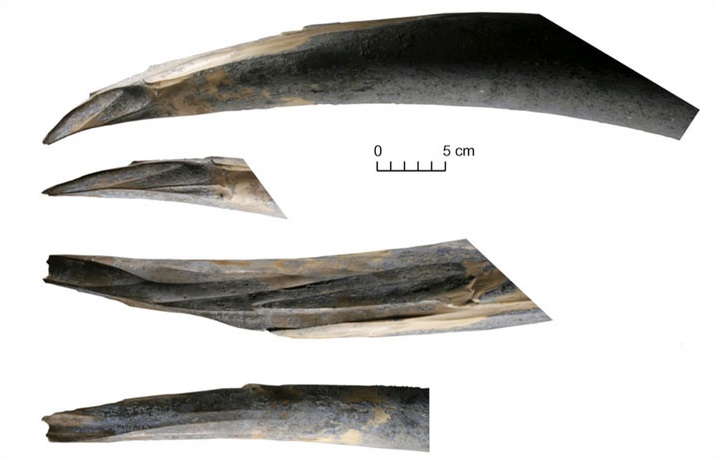
The scientists dug out the remains of the mammoth skeleton from the thawing permafrost and found the tusk had evidence of human handiwork.


"Traces of processing, presumably by an ancient man, were found on the tusk fragments," said mammoth expert Innokenty Pavlov who found the remains.

Slivers of ivory have sharp edges, useful for butchering, but also used by ancient man for killing, for example in spears.

Ancient ‘weapon-making site’ discovered beside skeleton of woolly mammoth
The scientists dug out the remains of the mammoth skeleton from the thawing permafrost 
[Credit: Innokenty Pavlov]
"The state of tusk remnants clearly points that the humans sliced it to make implements (and weapons)."


The palaeontologists are not certain yet that this beast was hunted and will undertake further study, but it appears to have a hunting wound on a lower rib.

The remains of the extinct beast weighing 23.6kg are being taken back to regional capital Yakutsk for further detailed study.

Ancient ‘weapon-making site’ discovered beside skeleton of woolly mammoth
The ivory spades dated as 28,500 and 12,000 - 10,000 years were found in Yakutia 
[Credit: Michil Yakovlev]
"We will do radiocarbon dating of the remnants, but for now we can say that the age of the tusk is not less than 10,000 years old," he said.


The expedition was organised with the help of Russian Geographical Society and Russian Ministry of Defence. Pavlov and his team are from the Academy of Sciences of Yakutia.

In the Pleistocene Era, this island was connected to the mainland. It is a well-known mammoth necropolis. Other sites also show human activity here at the time.


The site is close to a pygmy woolly mammoth’s last resting place. The scientists had hoped to excavate the pygmy - up to 50,000 years old -  this summer but were unable to do so because its grave was waterlogged.

Author: Anna Liesowska | Source: The Siberian Times [June 23, 2019]