Theme images by kelvinjay. Powered by Blogger.

USA

AFRICA

ASIA

Brazil

Portugal

United Kingdom

Switzerland

Chinese, Japanese archaeologists reconstruct millennia-old iron-smelting techniques


Chinese and Japanese archaeologists have successfully reconstructed the iron-smelting techniques that date back about two millennia.

Chinese, Japanese archaeologists reconstruct millennia-old iron-smelting techniques
Credit: Sichuan Observer


Based on the archaeological discovery of the Han Dynasty (206 BC-AD 220), archaeologists built a shaft furnace and successfully smelted pig iron in an experiment conducted over the weekend in the city of Qionglai in southwest China's Sichuan Province.

Chinese, Japanese archaeologists reconstruct millennia-old iron-smelting techniques
Credit: Sichuan Observer
The experiment provides data and a successful case for the study of iron-smelting techniques in the Han Dynasty, according to the archaeologists.

Chinese, Japanese archaeologists reconstruct millennia-old iron-smelting techniques
Credit: Sichuan Observer


The experiment was jointly sponsored by Sichuan University, the institutes of cultural relics and archaeology in Chengdu and Sichuan, Japan's Ehime University and the municipal government of Qionglai.

Chinese, Japanese archaeologists reconstruct millennia-old iron-smelting techniques
Credit: Sichuan Observer
Iron is regarded as one of the most important materials of Chinese civilization. Ancient Chinese were able to refine liquid iron as early as the Spring and Autumn Period (770 BC-476 BC).

Chinese, Japanese archaeologists reconstruct millennia-old iron-smelting techniques
Credit: Sichuan Observer
Li Yingfu, vice dean of the College of History and Culture of Sichuan University, said the iron-smelting techniques in the Han Dynasty not only greatly promoted production in ancient China, but also contributed to the development of metallurgy in Southeast Asia and beyond.

Source: Xinhua News Agency [November 19, 2019]

Horse-head statue looted by Anglo-French allied forces during Second Opium War in 1860 repatriated to China


A bronze horse head will be returned to the Old Summer Palace, or "Yuanmingyuan" in Chinese, according to China's National Cultural Heritage Administration (NCHA).

Horse-head statue looted by Anglo-French allied forces during Second Opium War in 1860 repatriated to China
The horse-head statue is among the 12 statues of Chinese Zodiac signs looted from the royal garden of 
Old Summer Palace in Beijing by Anglo-French allied forces during the Second Opium War in 1860
[Credit: China Daily]


It is the first repatriated animal head that will be housed at its original location, the Old Summer Palace.

Twelve animal head sculptures once formed a zodiac water clock in Beijing's Yuanmingyuan, built by Emperor Qianlong (1736-1795). The originals were looted from the royal garden by Anglo-French allied forces during the Second Opium War in 1860.

The horse head, designed by Italian artist Giuseppe Castiglione and crafted by royal craftsmen, is an artistic blend of East and West.

Horse-head statue looted by Anglo-French allied forces during Second Opium War in 1860 repatriated to China
Seven animal-head statues (the horse-head is second from right) that have returned to Beijing
are juxtaposed at the National Museum of China [Credit: Wang Kaihao/China Daily]


Macao billionaire Stanley Ho bought the bronze horse head in 2007 at auction and publicly displayed it in Hong Kong and Macao for many years. Ho decided to donate it to the NCHA and return it to its original palace home this month.

Through the efforts of Chinese government authorities and social forces, seven of the 12 lost sculptures have been brought back home by different means, while five remain missing.

The horse head sculpture will also join the ongoing exhibition at the national museum which runs through late November, along with the six other retrieved animal heads and returned relics.

Source: Xinhua News Agency [November 14, 2019]

800-year-old tomb found in north China


A tomb dating back 830 years to the Jin Dynasty (1115-1234) has been found in northern China, local authorities said Monday.

800-year-old tomb found in north China
Credit: Sina News


The tomb was discovered on the site of a natural gas pipeline project in Liulin Village, Xingtai County of Hebei Province, according to the county's institute of cultural relics and archaeology.

800-year-old tomb found in north China
Credit: Sina News


The round-shaped tomb is 1.9 meters tall, 1.9 meters wide and 1.7 meters long with tile frescoes on the vault.

800-year-old tomb found in north China
Credit: Sina News


Archaeologists were able to tell the age of the tomb from the inscribed dateline and believe that it belonged to a local gentleman or landlord.

800-year-old tomb found in north China
Credit: Sina News
"The tomb will provide valuable materials for research on the local funeral institution, burial custom and social conventions at that time," said Hua Penghui, head of the institute.

Two other tombs were also found nearby and are under excavation.

Source: Xinhua News Agency [November 10, 2019]

Ancient pottery fragment depicting female shaman found in Japan


A pottery fragment depicting a shaman with breasts has been found for the first time at a dig site here, shedding light on the religious role women played in ancient agriculture.

Ancient pottery fragment depicting female shaman found in Japan
An earthenware fragment showing a female shaman with arms extended
in a religious pose [Credit: Taku Hosokawa]
The figure on the artifact, dating to the first century BC, has her arms raised in what appears to be a pose to pray for bountiful harvests.

It was unearthed at the Shimizukaze archaeological site straddling Tawaramoto and Tenri in the prefecture, where burial-related and housing remains from the Yayoi Pottery Culture period (300 BC-AD 300) were also found.


While figures spreading or raising their arms appear on some of more than 40 earthenware paintings depicting a human from the Yayoi period found across Japan, the discovery is especially significant because it indicates that the individuals in such poses are invariably women.

Tawaramoto’s education board said that the earthenware piece measuring up to 16 centimeters wide and 12 cm long is believed to have been a section between the mouth and center of a large pot.

It was discovered at the former site of a river from the mid-Yayoi period when a 40-square-meter area was surveyed between May and June.

Ancient pottery fragment depicting female shaman found in Japan
Credit: Taku Hosokawa


The figure has wing-like sleeves, and the face has been illustrated with eyes, eyebrows, nose and mouth.

Spreading both arms is known as the “tamafuri” pose and is said to help revitalize and revive souls to pray for good harvests by giving vitality to rice plants.

Yoshiki Fukasawa, a visiting professor of archaeology at Tenri University, noted the possibility of the depicted woman having served as a shaman like noted Queen Himiko, who is mentioned in China’s “Gishi Wajinden” (Accounts of the Wa people, Records of Wei).

“The artifact was created 300 years earlier than the era of Himiko, who served as a priestess,” said Fukasawa. “The primary discovery shows that a tradition existed on the Japanese archipelago where women played a part in religious services, and that Himiko emerged against this historical background.”

Author: Takumi Okada | Source: The Asahi Shimbun [October 31, 2019]

Foundations for vanished 9th century Buddhist temple hall discovered in Kyoto


The stone platform upon which a 9th century Buddhist lecture hall once stood have been unearthed at the site of Saiji temple, demolished centuries ago, according to an announcement by Kyoto city officials. The foundation for what is thought to have been a five-storey pagoda was also discovered.

Foundations for vanished 9th century Buddhist temple hall discovered in Kyoto
These ruins are thought to have been a five-storey pagoda inside Saiji temple
in Kyoto’s Minami Ward [Credit: 
Mainichi/Masateru Sawaki]
According to Kyoto's department for the protection of cultural assets, this is the first time that structural remnants of the vanished temple's main buildings have been discovered. The platform stones are the first building remnants ever found from the ancient Japanese capital of Heian-kyo, as Kyoto was known during the Heian period (794-1185).


"These are very valuable findings to know about what it was really like at Saiji temple, a major temple which along with its counterpart Toji temple was one of Heian-kyo's signature structures," city officials emphasized. The "sai" in Saiji means "west," and the "to" in Toji means east.

Foundations for vanished 9th century Buddhist temple hall discovered in Kyoto
The platform stones for a Buddhist lecture hall are seen at the Saiji temple excavation site
in Kyoto's Minami Ward [Credit: Mainichi/Masateru Sawaki]
Toji temple is designated as a UNESCO World Heritage site. Saiji was abolished during the Kamakura period from the 12th to 14th centuries.


City authorities began the temple dig at two sites at the end of September. One consisted of two excavations totaling about 152 square meters in a park at the center of the former temple. The other extended about 174 square meters across three excavations in a residential area that was once the southwest corner of the ancient complex.

Foundations for vanished 9th century Buddhist temple hall discovered in Kyoto
An artist's concept of Saiji temple. The five-storey pagoda is in the left corner in the foreground
[Credit: Kyoto Dept. of Protection for Cultural Assets]
Researchers found the about 1.5-meter-tall platform stones, traces of the lecture hall's front steps, a cornerstone, four holes where cornerstones were missing, and foundation stones for walls and other structures. The platform is thought to have been built in 832.

Kindai University archaeology professor Nobuya Ami commented on the discoveries, "I was surprised that structural elements of Saiji temple remain in such good condition. It is an epochal find for understanding Heian period buildings."

Source: The Mainichi [October 26, 2019]

2,000 year-old tomb unearthed in east China


Chinese archaeologists have uncovered a batch of cultural relics from a tomb dating back around 2,000 years in eastern China's Jiangsu Province.

2,000 year-old tomb unearthed in east China
Credit: China Org


The ancient tomb was found in Donghai County in the city of Lianyungang. Staff at the county's museum said they have excavated a bronze statue, a mirror decorated with animal patterns and three iron swords from the tomb. Dozens of ancient coins were also unearthed, but all are in poor condition.

2,000 year-old tomb unearthed in east China
Credit: China Org


After on-site investigation and clean-up, archaeologists concluded that the owners of the tomb are a couple and the burial occurred during the Eastern Han Dynasty (25 A.D. - 220 A.D.).

2,000 year-old tomb unearthed in east China
Credit: China Org
Excavation of these cultural relics provides rare materials for further research on local history and culture, experts said.

Source: Xinhua News Agency [October 14, 2019]

Two large-scale palatial structures discovered in China's Inner Mongolia Autonomous Region


Chinese archaeologists have discovered two large-scale palatial structures in northern China's Inner Mongolia Autonomous Region.

Two large-scale palatial structures discovered in China's Inner Mongolia Autonomous Region
Credit: CCTV
The structures were found in the millennium-old ruins of the capital city of the Liao Dynasty (916-1125) by archaeologists with the Chinese Academy of Social Sciences (CASS) and regional institute of cultural relics and archaeology of Inner Mongolia.

The first structure is a pavilion-style building built on a well-preserved two-metre-tall rammed earth platform with a side length of 51 metres. Covering about 1,100 square metres, the building is the largest palatial structure found in the ancient Liao capital to date.


During the Jin Dynasty (1115-1234), the building was destroyed and a smaller one was later built on its foundation.


The other structure is a rectangular courtyard surrounded by cloisters on all four sides. With its gate opened in the middle of the east wall and the main hall located in the middle of the western end, the courtyard bore typical characteristics of Liao Dynasty constructions.

Dong Xinlin, an archaeologist with the CASS, said that the discovery of the two large structures provides important information for the study of the layout of the capital of the Liao Dynasty.

During the excavation, archaeologists also unearthed a large number of artefacts from the Liao and Jin dynasties, including precious stone Buddha statues, architectural components, iron knives and porcelain.

Source: Xinhua News Agency [October 12, 2019]

Remains of possible noble's residence found near Japan's ancient capital in Nara


The archaeological remains of what may have been the residence of a noble have been excavated at Fujiwarakyo, the ancient capital of Japan from 694 to 710, the prefectural institute announced earlier this month.

Remains of possible noble's residence found near Japan's ancient capital in Nara
The newly excavated archaeological site of buildings believed to have been the residence of a noble is seen
near the ancient Japanese capital of Fujiwarakyo in the city of Kashihara, Nara Prefecture
[Credit: Archaeological Institute of Kashihara]
According to the Archaeological Institute of Kashihara, the site is located about 2 kilometers away from what was the center of the ancient castle town. The size of the plot, which measures about 130 meters on each side, suggests that it may have belonged to a noble. To date, plots of this size -- granted to members of the aristocracy -- were all found close to the center of the ancient capital. The latest discovery suggests that nobles may have lived further from the capital's center than originally thought.


The remains were unearthed during excavation ahead of the construction of a new campus of Nara Medical University. Traces of what may be the main part of the residence measured about 13.5 meters from east to west and 5.4 meters from north to south. Signs of a gate, fence and annex were also found.

Hitoshi Hayashibe, a deputy director of the National Museum of Japanese History, said that based on the location of the plot, "there could have been no rule in Fujiwarakyo that the nobility were to be given lots for their residences near the imperial palace like in Heijokyo (the ancient capital after Fujiwarakyo)."

Some archaeologists, however, hold the view that the remains were not of a noble's residence. Tsuyoshi Ozawa, a professor at Mie University, paid attention to the structure believed to have been the gate and said, "I guess that it was a kind of government office."

Source: The Mainichi [October 10, 2019]

Horse-shaped pottery unearthed at South Korean Tomb site


A horse-shaped earthenware object, the largest of its kind in the country’s history, has been excavated at the Geumryeongchong Tomb site in Gyeongju, North Gyeongsang Province. The presence and location of the objects excavated within and around the tumuli suggest that the tomb belonged to a king, not a young member of a royal family as presumed before.

Horse-shaped pottery unearthed at South Korean Tomb site
Credit: Dong-A Ilbo
“We’ve recently excavated some 30 earthenware pots used for ancestral rites near the tomb, which had been unearthed during the Japanese colonial era,” the Gyeongju National Museum announced, saying it turns out that the tomb is likely to have been built above the ground, not from underground as previously known.


The Silla Dynasty’s tomb, presumed to date back to the late 5th century or the early 6th century, is where a pair of the pottery in the shape of a warrior on horseback, the National Treasure No. 91, had been excavated. The horse-shaped pottery discovered during the latest investigation is 56 centimeters high, and has delicately formed face, jaw, neck, and hooves. Along with it, earthenware for memorial services also turned up. Given that parts of it were neatly cut off, the pottery seems to have been intentionally broken and dedicated to the tomb.

It is also noteworthy that over 30 jars filled with offerings such as oysters and clams were found out, located with a consistent space between them. The Gold Bell Tomb turned out to be 28 meters in diameter, eight meters larger than previously known, but is still not one of the largest tombs in the country. Yet, the tomb had more jars for rituals even than Seobongchong, a bigger tomb located nearby. Inside and outside the earthenware, some bones of animals such as a horse and a cow, a plate with a cover, bells, and glass beads were also excavated. Shin Gwang-cheol, a curator at the museum, explained that the floor where the earthenware was found out indicates the process of building the tomb and holding grand memorial services several times.


Some suggest that Geumryeongchong was a royal tomb. A gold crown of the Silla Kingdom (Treasure No. 338), gold bells, belts, jade bracelets, and a large sword had been discovered near the tomb, but since most accessories were small, experts presumed that the tomb belonged to a young member of a royal family, not a king. However, Park Kwang-choon, a professor at the Department of Archaeology and Art History at Dong-A University, said that the discovery of a prop, which had been found only near royal tombs, as well as the scale of rituals hint at a possibility that it is a royal tomb of a king.

An excavation study into Geumryeongchong was conducted in 1924, but the soil and stones that covered and surrounded the burial mound were not investigated back then. This is why the tomb was incorrectly known for being an underground grave, unlike other kingdom sites built during the Silla Dynasty. The Gyeongju National Museum is set to excavate the mound again by next year.

Author: Jong-Yeob JO | Source: Dong-A Ilbo [October 02, 2019]

Archaeological site in Inner Mongolia formed 9,000 years ago


A recent analysis has validated the exact age of a prehistoric settlement in northern China's Inner Mongolia Autonomous Region, local experts said Friday.

Archaeological site in Inner Mongolia formed 9,000 years ago
Aerial view of the Simagou site in Huade county, Northwest China's Inner Mongolia
autonomous region [Credit: China News Service]


The carbon-14 test conducted by a U.S. laboratory showed the Simagou ruins in Huade County could date back to 9,000 years ago in the Neolithic period, according to the regional institute of cultural relics and archaeology.

Archaeological site in Inner Mongolia formed 9,000 years ago
View of the excavations at the Simagou site in Huade county, Northwest China's Inner Mongolia
autonomous region 
[Credit: China National Daily]
Bao Qingchuan, a researcher with the institute, said the ruins were believed to be the earliest site of the Neolithic period ever found in vast steppes of northern China, and the discovery is of great significance to Chinese archaeology.

Archaeological site in Inner Mongolia formed 9,000 years ago
 Bao Qingchuan, a researcher with the Inner Mongolia Autonomous Region Institute of Archaeology, said the
remains have been radiocarbon dated to approximately 7000-9000 years ago [Credit: 
Weibo]


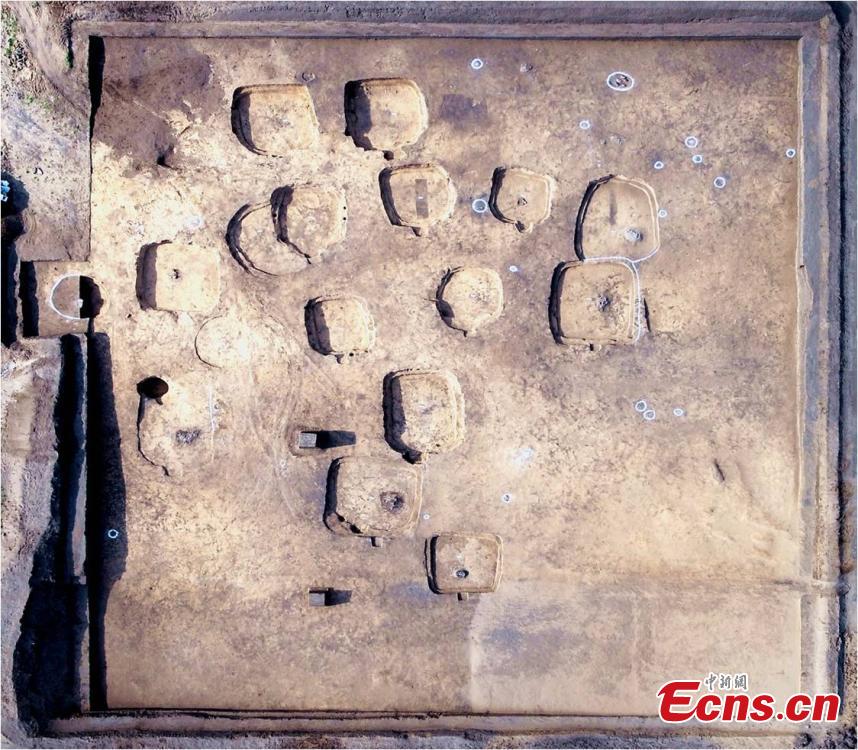
From 2017 to 2019, archaeologists discovered 19 houses and 19 outdoor cooking ranges covering an area of over 2,200 square meters on the Simagou site. The houses are of different shapes, including circle and rectangle.

Archaeological site in Inner Mongolia formed 9,000 years ago
Stone tools discovered at the Simagou site in Huade county, Northwest
China's Inner Mongolia autonomous region
 [Credit: China Times]
So far, over 4,000 items such as stone tools, bone artifacts and pottery shards have been unearthed from the Simagou ruins.

Archaeological site in Inner Mongolia formed 9,000 years ago
Stone pestles and querns discovered at the Simagou site in Huade county, Northwest China's
Inner Mongolia autonomous region
 [Credit: China National Daily]


Archaeologists said the ruins might be related to the Yumin ruins, another prehistoric settlement found in the same county. They are likely to have belonged to the same clan, which migrated to the Simagou settlement in spring and summer and moved to the Yumin ruins when temperatures dropped.

Archaeological site in Inner Mongolia formed 9,000 years ago
View of the Simagou site in Huade county, Northwest China's Inner Mongolia
autonomous region
 [Credit: China National Daily]
"The discovery can provide clues for archaeologists to probe into the origin of the culture of the Neolithic age and the advent of primitive agriculture and animal husbandry in northern China," Bao said.

Source: Xinhua News Agency [September 20, 2019]

Millennium-old royal tomb found in north China


Chinese archaeologists have uncovered a royal tomb dating back around 1,000 years in north China's Inner Mongolia Autonomous Region, according to the regional institute of cultural relics and archaeology.

Millennium-old royal tomb found in north China
Figure shows the crane pattern mural at the top of the main burial chamber
[Credit: China News Services]


Found in Kailu County in eastern Inner Mongolia, the ceiling of the single-chamber tomb is decorated with crane-patterned murals. Archaeologists also unearthed valuable burial objects such as glass and gold wares, as well as a coping stone made of two huge pieces of granite, which was likely sourced from outside the area, archaeologists said.

Millennium-old royal tomb found in north China
Glassware unearthed from the tomb in Kailu county, North China's Inner Mongolia autonomous region
[Credit: China News Services]


Based on its structure and design, the tomb was probably built in the early Liao Dynasty (916-1125) and belonged to the royal family, said Lian Jilin, a researcher at the institute, noting that the occupant has yet to be identified.

Millennium-old royal tomb found in north China
Gold pin unearthed from the tomb in Kailu county, North China's Inner Mongolia autonomous region
[Credit: China News Services]
A royal tomb cluster was discovered 1 km away three years ago, which provided important materials for further research on the specific position of Longhua State, an ancient city built in 902 by Yelu Abaoji (Emperor Taizu of Liao), khagan of the nomadic Khitans who once ruled the northern part of China.

Excavation and further research are underway.

Source: ECNS [September 16, 2019]

New study shows common carp aquaculture in Neolithic China dating back 8,000 years


In a recent study, an international team of researchers analyzed fish bones excavated from the Early Neolithic Jiahu site in Henan Province, China. By comparing the body-length distributions and species-composition ratios of the bones with findings from East Asian sites with present aquaculture, the researchers provide evidence of managed carp aquaculture at Jiahu dating back to 6200-5700 BC.

New study shows common carp aquaculture in Neolithic China dating back 8,000 years
Preparing to drain the field at Matsukawa village, Japan
[Credit: Mark Hudson]
Despite the growing importance of farmed fish for economies and diets around the world, the origins of aquaculture remain unknown. The Shijing, the oldest surviving collection of ancient Chinese poetry, mentions carp being reared in a pond circa 1140 BC, and historical records describe carp being raised in artificial ponds and paddy fields in East Asia by the first millennium BC.


But considering rice paddy fields in China date all the way back to the fifth millennium BC, researchers from Lake Biwa Museum in Kusatu, Japan, the Max Planck Institute for the Science of Human History in Jena, Germany, the Sainsbury Institute for the Study of Japanese Arts and Cultures in Norwich, U.K., and an international team of colleagues set out to discover whether carp aquaculture in China was practiced earlier than previously thought.

Carp farming goes way back in Early Neolithic Jiahu

Jiahu, located in Henan, China, is known for the early domestication of rice and pigs, as well the early development of fermented beverages, bone flutes, and possibly writing. This history of early development, combined with archaeological findings suggesting the presence of large expanses of water, made Jiahu an ideal location for the present study.

Researchers measured 588 pharyngeal carp teeth extracted from fish remains in Jiahu corresponding with three separate Neolithic periods, and compared the body-length distributions with findings from other sites and a modern sample of carp raised in Matsukawa Village, Japan.

New study shows common carp aquaculture in Neolithic China dating back 8,000 years
This is co-author Junzo Uchiyama preparing to measure common carp
removed from the paddy field [Credit: Mark Hudson]
While the remains from the first two periods revealed unimodal patterns of body-length distribution peaking at or near carp maturity, the remains of Period III (6200-5700 BC) displayed bimodal distribution, with one peak at 350-400 mm corresponding with sexual maturity, and another at 150-200 mm.

This bimodal distribution identified by researchers was similar to that documented at the Iron Age Asahi site in Japan (circa 400 BC - AD 100), and is indicative of a managed system of carp aquaculture that until now was unidentified in Neolithic China.


"In such fisheries," the study notes, "a large number of cyprinids were caught during the spawning season and processed as preserved food. At the same time, some carp were kept alive and released into confined, human regulated waters where they spawned naturally and their offspring grew by feeding on available resources. In autumn, water was drained from the ponds and the fish harvested, with body-length distributions showing two peaks due to the presence of both immature and mature individuals."

Species-composition ratios support findings, indicate cultural preferences

The size of the fish wasn't the only piece of evidence researchers found supporting carp management at Jiahu. In East Asian lakes and rivers, crucian carp are typically more abundant than common carp, but common carp comprised roughly 75% of cyprinid remains found at Jiahu. This high proportion of less-prevalent fish indicates a cultural preference for common carp and the presence of aquaculture sophisticated enough to provide it.

Based on the analysis of carp remains from Jiahu and data from previous studies, researchers hypothesize three stages of aquaculture development in prehistoric East Asia. In Stage 1, humans fished the marshy areas where carp gather during spawning season. In Stage 2, these marshy ecotones were managed by digging channels and controlling water levels and circulation so the carp could spawn and the juveniles later harvested. Stage 3 involved constant human management, including using spawning beds to control reproduction and fish ponds or paddy fields to manage adolescents.

Although rice paddy fields have not yet been identified at Jiahu, the evolution of carp aquaculture with wet rice agriculture seems to be connected, and the coevolution of the two is an important topic for future research.

The findings are published in Nature Ecology & Evolution.

Source: Max Planck Institute for the Science of Human History [September 16, 2019]

2,000-year-old tomb complex found in central China


A large tomb complex dating back around 2,000 years was discovered in the city of Sanmenxia in central China's Henan Province, local authorities announced.

2,000-year-old tomb complex found in central China
Credit: Sina News


The site was found during road construction in the city of Lingbao, a county-level city in Sanmenxia, according to the Sanmenxia institute of cultural heritage and archaeology.

2,000-year-old tomb complex found in central China
Credit: Sina News


Based on the structural characteristics of the complex and the unearthed cultural relics, cultural workers in the institute said the site belonged to the Han Dynasty (202 BC - 220 AD).

2,000-year-old tomb complex found in central China
Credit: Sina News


The complex, consisting of many family tomb groups, has 76 ancient tombs. More than 720 cultural relics such as bronzeware, pottery and ironware were excavated. A rare seal of the tomb owner was also found at the location.

2,000-year-old tomb complex found in central China
Credit: Sina News
The discovery is one of the largest in Lingbao, which can help with the study of politics, culture and economy in the Han Dynasty, according to the cultural experts.

Source: Xinhua News Agency [September 12, 2019]

Gilded silver dragons among treasures found in Mongolian tomb


Among a trove of gold, silver, bronze, jade and wood artifacts, two gilded silver dragons attracted the eyes of Chinese archaeologists taking part in a joint field excavation project in Mongolia.

Gilded silver dragons among treasures found in Mongolian tomb
The two gilded silver dragons unearthed from the tombs of Xiongnu aristocrats in north-central Mongolia
[Credit: Henan Provincial Institute of Cultural Relics and Archaeology]
The work on the tombs of Xiongnu aristocrats in north-central Mongolia has entered its third year. In July, the Sino-Mongolian joint team completed the excavation of one of the 400 tombs, numbered M189, in which the gilded silver dragons were unearthed.


"The dragons, each 8 cm in length and with a gesture looking back to its vertical tail, bear obvious characteristics of the Western Han Dynasty (206 B.C.-A.D. 25)," said Dr. Lan Wanli, head of the Chinese archaeological team.

Gilded silver dragons among treasures found in Mongolian tomb
The two gilded silver dragons as they were found in the M189 tomb [Credit: Henan Provincial
Institute of Cultural Relics and Archaeology]
Details of the dragons' horns, eyes, teeth and feathers were exquisitely carved. Experts suspect they were ornaments attached to a decorative vessel.


Lan said the two gilded silver dragons not only testify to the cultural exchange and interaction between the prairie in the north and central China, but also indicate that the owner of the tomb had a high status in Mongol society.

Gilded silver dragons among treasures found in Mongolian tomb
Gold ornaments retrieved from the M189 tomb [Credit: Henan Provincial
Institute of Cultural Relics and Archaeology]


Gilded silver dragons among treasures found in Mongolian tomb
Turquoise and jade ornaments retrieved from the M189 tomb [Credit: Henan Provincial
Institute of Cultural Relics and Archaeology]


Gilded silver dragons among treasures found in Mongolian tomb
Remains of bronzeware retrieved from the M189 tomb [Credit: Henan Provincial
Institute of Cultural Relics and Archaeology]
The Xiongnu people were an alliance of nomadic tribes also known as the Huns that emerged around the end of the third century B.C. and had a huge impact on Chinese and world history. During the Han Dynasty, the Xiongnu and the Chinese imperial court clashed several times.

"The tomb in Mongolia predates most of the previously discovered Xiongnu aristocratic tombs in Russia and Mongolia," said Lan.

Gilded silver dragons among treasures found in Mongolian tomb
The excavation site of the tombs of Xiongnu aristocrats in north-central Mongolia
[Credit: Henan Provincial Institute of Cultural Relics and Archaeology]
He said the archaeological team also unearthed a jade belt hook, wooden cups, leather horse harness and other household utensils, chariots and weapons from the tomb.

"The bottom of the coffin is covered with a layer of fabric, followed by a layer of unhusked millet, with a small amount of chenopodium, covered with fabric, followed by a layer of unhusked millet and a large amount of sawdust, mixed with small pieces of charcoal and chenopodium, and another layer of fabric," he said.

This kind of arrangement was found for the first time in the tombs of Xiongnu aristocrats, Lan said.

Source: Xinhua News Agency [September 10, 2019]