Theme images by kelvinjay. Powered by Blogger.

USA

AFRICA

ASIA

Brazil

Portugal

United Kingdom

Switzerland

Ground penetrating radar reveals why ancient Cambodian capital was moved to Angkor


The largest water management feature in Khmer history was built in the 10th century as part of a short-lived ancient capital in northern Cambodia to store water but the system failed in its first year of operation, possibly leading to the return of the capital to Angkor.

Ground penetrating radar reveals why ancient Cambodian capital was moved to Angkor
Regional map of Koh Ker showing the location of the chute and key archaeological features. The detailed
map area (top right) is shown as a white dashed box on the regional map (left). The black dashed line
in the detailed map area shows the approximate area of Fig 2. The location of Koh Ker compared with
Angkor, Phnom Penh, and Ho Chi Minh City is shown in the bottom right. North is up in all figures
[Credit: Dr Ian Moffat, Flinders University]
An international team of researchers led by Dr Ian Moffat from Flinders University in Australia used ground penetrating radar to map the surface of a buried spillway in Koh Ker to better understand why the reservoir failed during its first year of use.

In a study published in Geoarchaeology, archaeologists explain that the 7km long embankment was designed to capture water from the Stung Rongea river but modelling indicates it was inadequate to contain the average water flow in the catchment, putting into question the legitimacy of Khmer kings, and forcing them to re-establish their capital in Angkor.

"At that time, embarking on projects of civil engineering such as temple building, urban renewal, and the development of water infrastructure was central to establishing the legitimacy of Khmer kings," says Dr Moffat


"It's not difficult to envisage that the failure of the embankment at Koh Ker--the largest and most ambitious infrastructure project of the era--may have had a significant impact on the prestige of the sovereign capital, and contributed to the decision to re-establish Angkor as the capital of the Khmer Empire."

"Our study shows that this ambitious engineering feat was always doomed to rapid failure."

The monumental complex of Koh Ker, located 90 km northeast of Angkor, remains relatively poorly understood even though it was briefly the capital in the middle of the 10th century CE under King Jayavarman IV, the only capital throughout six centuries to be established outside of the Angkor region.

The site is located in an area of gently sloping hills and stone outcrops, far removed from the low-lying floodplains that define the Khmer heartland.

Source: Flinders University [October 31, 2019]

Ancient 'lost city' of Khmer Empire found in Cambodia


An ancient 'lost city' of the Khmer Empire has been rediscovered in Cambodia by scientists using aerial mapping techniques, a new report has revealed.

Ancient 'lost city' of Khmer Empire found in Cambodia
An aerial view of the ancient city of Mahendraparvata 
[Credit: Chevance et al. 2019]
Mahendraparvata - an eighth to ninth century capital of the empire - was believed to have existed in the Southeast Asian state in the Angkor period, but scientists had struggled to pinpoint its location.

An international group of researchers have now used aerial laser scanning and ground-based surveying to uncover an 'extended urban network dating from the ninth century' which they identified as Mahendraparvata.


Archaeological evidence of the ancient settlement had previously been limited to 'scatter of small and apparently isolated shrines'.

But in the report, which was published in the Antiquity journal this week, the researchers claimed they have located the Angkor-period capital on the Phnom Kulen plateau, south of the Dangrek Mountains.

Ancient 'lost city' of Khmer Empire found in Cambodia
A map of the "lost city" of Mahendraparvata in Phnom Kulen, Cambodia
[Credit: Chevance et al. 2019]
Scientists had previously theorized that the ancient city was located on the plateau, north of Siem Reap, but until recently it had been difficult to find evidence due to the dense Cambodian jungle and remote location.

It was also believed the area was littered with landmines leftover from the Khmer Rouge, who occupied the Phnom Kulen from the early 1970s until the late 1990s.


The researchers, with the use of aerial laser scanning known as lidar, were able to find evidence of a centrally planned urban area' which spanned 40 to 50 square kilometres on the plateau. 

Mahendraparvata was said to be laid out in a grid system, with a 'distribution of small shrines, mounds and ponds' and a large-scale water management system.

Ancient 'lost city' of Khmer Empire found in Cambodia
A newly documented temple site found in the forests of the Phnom Kulen, Cambodia
[Credit: Chevance et al. 2019]
Other discoveries include evidence of a royal palace and a state pyramid-temple - two infrastructure features said to typically be found in Khmer Empire capitals.

'Here, we confirm the hypothesis, based on this accumulated body of evidence, that Mahendraparvata -- the eighth- to ninth-century AD capital of the Khmer Empire -- was located on the Phnom Kulen massif', the report said.


'The work described here effectively draws to a close 150 years of archaeological mapping work in the Greater Angkor region and sets the stage for more sophisticated spatio-temporal modelling of urban form'.

Damian Evans, part of the five-strong research team, said the result was 'a very full and detailed interpretation of that city'.

Ancient 'lost city' of Khmer Empire found in Cambodia
Archaeological map of the Greater Angkor area [Credit: Chevance et al. 2019]
The new findings build on scans made in 2012 which confirmed the existence of Mahendraparvata, an ancient temple city near Angkor Wat.

Evans and his colleagues first found traces of extensive networks surrounding the monumental stone temple complex at Angkor Wat in June 2016. He said at the time that their findings could further our understanding of Khmer culture and throw into question traditional assumptions about the 15th-century decline of the empire.

For years, experts have assumed that the ancient Khmer civilization collapsed in the 15th century when invading Thai armies sacked Angkor Wat, forcing populations to relocate to southern Cambodia.

Angkor Wat, a UNESCO World Heritage site, is considered one of the ancient wonders of the world. It was constructed from the early to mid 1100s by King Suryavarman II at the height of the Khmer Empire's political and military power and was among the largest pre-industrial cities in the world.

Author: Faith Riddler | Source: Daily Mail [October 18, 2019]

Bodhisattva statue unearthed in Cambodia


The Apsara National Authority technical team uncovered a sandstone statue of a Bodhisattva while carrying out excavation work at the east entrance of the Ta Nei temple this week.

Bodhisattva statue unearthed in Cambodia
Credit: Apsara Authority
The team was trying to find the temple’s roof stone, which had fallen into a pile of stones in land covered with anthills.

Ta Nei temple’s restoration project leader Sea Sophearun, who is also an archaeologist at the Department of Monuments and Preventive Archaeology said his team had only uncovered the head of the statue.


The right ear is still intact but the left one is missing and it has a scraped nose with one side of the cheek damaged.

“Firstly, we cannot determine what caused the damage to the cheek. It might be a result of the statue crashing into something. Although the statue was uncovered at the location, there is no evidence to show the torso of the statue lies in the spot where we uncovered the head,” Sophearun said.

Bodhisattva statue unearthed in Cambodia
Credit: Apsara Authority
Chhouk Somala, an officer in charge of archaeological registration at the Department of Monuments and Preventive Archaeology said the head is 54cm in height, 27cm in width and has a depth of 36cm.

Somala said the Bodhisattva statue’s head was carved in the Bayon style during the late 12th and early 13th centuries, during the reign of Jayavarman VII.


In Mahayana Buddhism, the statue head is known as the Avloketesvar Bodhisattva, also known as “Guanyin” who embodies the compassion of all Buddhas.

In Khmer art, this kind of statues has two, four, or eight arms, holding Buddhist strings, books, a rose, and a vase. Also, the statue was carved like Bodhisattva Buddha.

Bodhisattva statue unearthed in Cambodia
Credit: Apsara Authority
Apsara National Authority spokesman Long Kosal said experts have kept the statue head temporarily on the premises of the Apsara National Authority. Then, it will be registered and have its photo taken as part of the documentation process.

Besides, experts will prepare the request to have the statue stored at the Angkor Centre for Conservation of Biodiversity (ACCB).

“After we have cleaned the statue’s head, we will study more about it. Then, in future we will exhibit it to the public,” said Kosal.

He said the Apsara National Authority team had always uncovered artefacts and statues in the Angkor area, but he could not provide the total number of such findings.

Author: Voun Dara | Source: Phnom Penh Post [October 13, 2019]

Art ring charged with smuggling $143 million in antiquities


An art dealer who authorities called one of the most prolific smugglers in the world and seven others were charged with trafficking more than $140 million in stolen antiquities, prosecutors said Wednesday.

Art ring charged with smuggling $143 million in antiquities
Three of the items seized by the Department of Homeland Security during the course of the investigation
into Subhash Kapoor and his co-defendants [Credit: Manhattan District Attorney’s Office]
Authorities described the case as one of the largest of its kind, saying the conspiracy began more than three decades ago and involved more than 2,600 recovered artifacts, including statues and ancient masterworks.

A criminal complaint filed in Manhattan state court said the smuggling was orchestrated by Subhash Kapoor, a New York art gallery owner who was arrested in Germany in 2011 and later extradited to India, where he faces similar charges. An email seeking comment was sent to Kapoor’s defense attorney.

The prosecution involves artifacts stolen from Afghanistan, Cambodia, India, Pakistan and other countries that were sold for profit to dealers and collectors around the world. Some of the items appeared in world-renowned museums without officials realizing they were ill-gotten gains.


“These are, in many instances, priceless works that represent the culture and history of the countries from which they were stolen,” Manhattan District Attorney Cyrus R. Vance Jr. told The Associated Press in an interview. “They are of enormous value.”

In all, authorities said, the network trafficked more than $143 million worth of antiquities. The international investigation was called “Operation Hidden Idol.”

The U.S. Department of Homeland Security has described Kapoor as “one of the most prolific art smugglers in the world.” He faces 86 counts in the criminal complaint, including grand larceny and criminal possession of stolen property.

Art ring charged with smuggling $143 million in antiquities
A sandstone stele of Rishabhanata from the 10th century, believed looted, seized in a raid of Christie’s
as part of an international investigation into former dealer Subhash Kapoor
[Credit: Department of Homeland Security]
The lead prosecutor, Matthew Bogdanos, told the AP that none of the defendants is believed to be in the United States. He said the authorities asked Interpol to issue international warrants for their arrest.

Kapoor, 70, owned the Art of the Past gallery on Manhattan’s Upper East Side, which authorities raided in early 2012.

The criminal complaint says Kapoor went to extraordinary lengths to acquire the artifacts, many of them statues of Hindu deities, and then falsified their provenance with forged documents.

It says Kapoor traveled the world seeking out antiquities that had been looted from temples, homes and archaeological sites.


Some of the artifacts were recovered from Kapoor’s storage units in New York.

Prosecutors said Kapoor had the items cleansed and repaired to remove any damage from illegal excavation, and then illegally exported them to the United States from their countries of origin.

“Kapoor would also loan stolen antiquities to major museums and institutions,” the complaint says, “creating yet another false veneer of legitimacy by its mere presence in otherwise reputable museums and institutions.”

The other defendants in the case include suppliers and restorers accused of conspiring with Kapoor.

Author: Jim Mustian | AP News [July 11, 2019]

Ancient statue found in Cambodia's Siem Reap


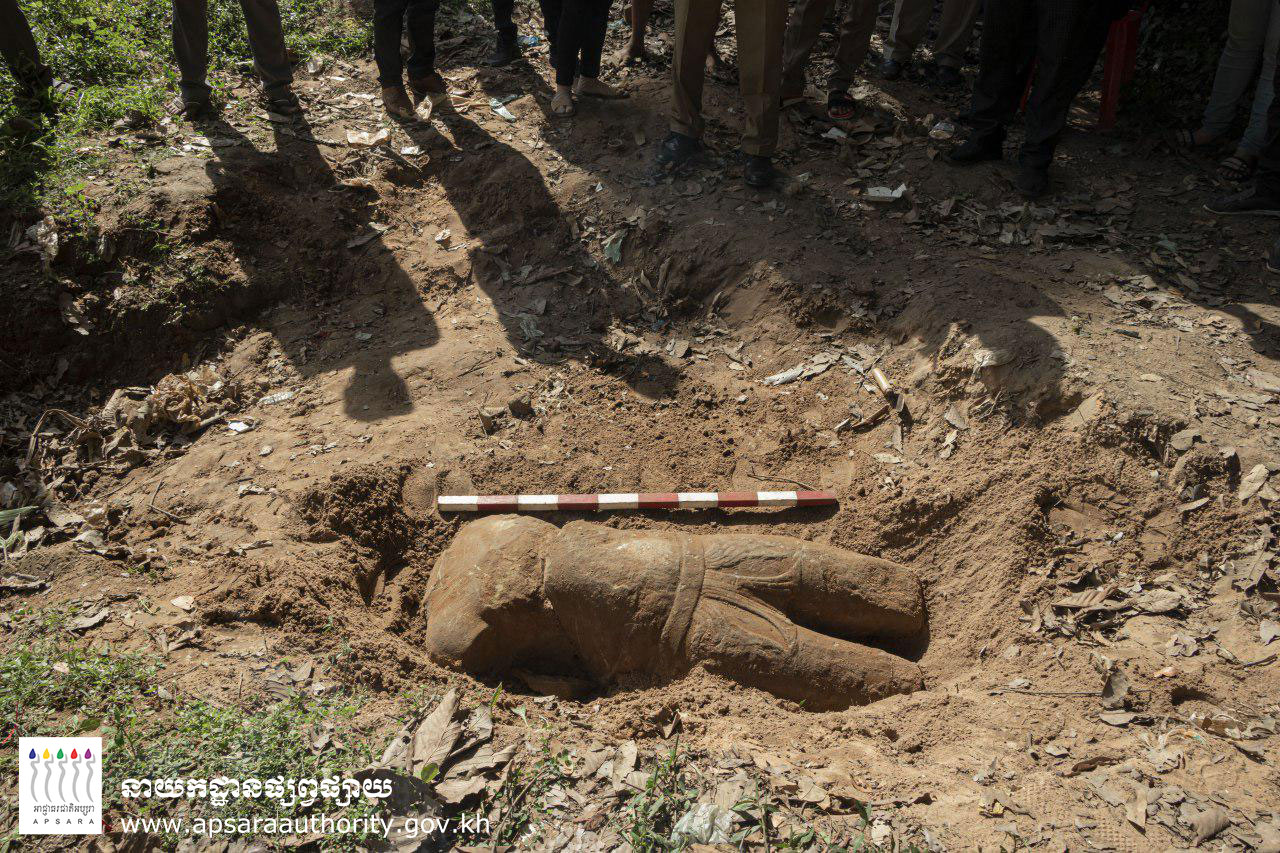
An incomplete piece of a statue measuring over one metre, thought to be an ancient remain, was found in the northeastern corner of Preah Ko temple in Siem Reap province’s Ov Lork village on Monday.

Ancient statue found in Cambodia's Siem Reap
Credit: Apsara Authority
Ly Vanna, director of the Department of Conservation of Monuments and Preventative Archaeology with the Apsara Authority, said the statue was incomplete, noting that only the body was found, while the head, both hands and feet were missing.


“The statue is made of sandstone, and there are carvings that depict a short skirt with fishtail patterns that sits above the knee, along with a belt,” he said. “The kind of clothing is similar to that of Vishnu of Preah Ko style, as a Vishnu statue is currently displayed in the National Museum in Phnom Penh.”

Ancient statue found in Cambodia's Siem Reap
Credit: Apsara Authority
“However, unfortunately the statue does not have a head or hands, which make it difficult to determine. If the statue had four hands, it can be confirmed as that of Vishnu,” he added. “But if it only has two hands, it could be Shiva. However, if we only rely on the outline of the statue, we can conclude that it is Vishnu from Brahmanism.”


He said that Apsara Authority would take the statue to clean and study for documentation before sending it for keeping in Preah Norodom Sihanouk-Angkor Museum in the future.

Ancient statue found in Cambodia's Siem Reap
Credit: Apsara Authority
Thai Mech, a resident who found the statue, was quoted by the Apsara Authority as saying that he often crossed Preah Ko temple moat, but he did not notice the statue before. However, when he passed the area on Monday, he dug the ground and found the statue, which measures 1.14 metres.


“At first, I did not think it was a statue, but looking at the shape of the stone I continued to dig and found the statue,” he said. “Afterwards, I reported it to the Heritage Protection Police for safety.”

Ancient statue found in Cambodia's Siem Reap
Credit: Apsara Authority
First Lieutenant Oun Yong, a heritage police in Angkor Archaeological Park’s Roluos, said people have discovered statues in the past and always reported it to the police for safe keeping and research.

“I would like to appeal to everyone who has found any statues or archaeological remains anywhere to please hand it over or report it to authorities for inspection,” he said.

Author: Pech Sotheary | Source: Khmer Times [July 10, 2019]

Japanese collector returns ancient artefacts to Cambodia


Millennium-old Cambodian artefacts displayed in a Japanese collector's home for two decades have been returned to the Southeast Asian country's National Museum.

Japanese collector returns ancient artefacts to Cambodia
Some 85 artefacts are displayed before the handover ceremony at the National Museum,
in Phnom Penh, Cambodia [Credit: Heng Sinith/AP]
The 85 artefacts are mostly small bronze items and include statues of Buddha and the Hindu god Shiva, plus jars, ceramics and jewelry. Cambodia's Culture Ministry says some items were older than the Angkor era, which began about 800 A.D. Others date from the Angkor era or just after it ended in the late 14th century.

Cambodia has made intense efforts to recover artefacts looted during its civil war in the 1970s.


At an official reception for the artefacts Friday, Prak Sonnara, secretary of state for the Culture and Fine Art Ministry, praised the Japanese collector for voluntarily returning the artefacts. He said her actions set a good sample for other countries and collectors to follow.

The collector, Fumiko Takakuwa, told reporters after the handover ceremony that she and her husband had bought the items in Japan and liked to collect and display them in their home. But she knew they were originally from Cambodia and that is why she returned them.

Japanese collector returns ancient artefacts to Cambodia
The 85 artefacts are mostly small bronze items and include statues of Buddha and the Hindu god Shiva,
plus jars, ceramics and jewellery
 [Credit: Heng Sinith/AP]


Japanese collector returns ancient artefacts to Cambodia
Cambodia has made intense efforts to recover artefacts looted during
its civil war in the 1970s [Credit: Heng Sinith/AP]
"My husband has said before he passed away that those artefacts have to be returned back to Cambodia, and today I am happy that I did," Takakuwa said.

Prak Sonnara said the 85 items were believed to have been stolen from Cambodia's temples during the war, when intense looting occurred and valuables were smuggled through neighboring Thailand.


A 1993 Cambodian law prohibited the removal of cultural artefacts without government permission. The law strongly compels owners of items taken abroad after that date to return them. But there is also general agreement in the art world that pieces were acquired illegitimately if they were exported without clear and valid documentation after 1970 — the year of a United Nations cultural agreement targeting trafficking in antiquities.

In 2014, three 1,000-year-old statues depicting Hindu mythology were welcomed home to Cambodia after being looted from a temple and put in Western art collections.

Also in 2013, two 10th century Cambodian stone statues displayed for nearly two decades at New York's Metropolitan Museum of Art were returned to their homeland in a high-profile case of allegedly looted artefacts.

Author: Sopheng Cheang | Source: The Associated Press [July 07, 2019]

Angkor pond dug for research


Supported by the Ministry of Culture and Fine Arts, Apsara Authority archaeologists are excavating the northern pond at Angkor Wat temple to learn more about its ancient structure. Once the research is complete, the pond will be restored and beautified.

Angkor pond dug for research
Apsara Authority archaeologists are excavating the northern pond at Angkor Wat temple
to learn more about its ancient structure [Credit: Sabay News]
Apsara Authority spokesperson Long Kosal told The Post on Monday that the archaeologists are looking to study the pond’s structure and foundations, which were built hundreds of years ago.


The authority issued a statement in February saying the work would commence on February 20 but did not at the time know when the project would be completed or what the total budget would ultimately be.

“Our archaeologists want to learn more about the pond’s design and structure, especially regarding the layers of rock in its foundations. They hope to discover what tools and materials our ancestors used. The pond used to be deeper than it is now, because soil flows in and settles, making it shallower. The pond actually serves no specific purpose, but tourists love it and enjoy taking pictures of the temple’s reflection in the water,” Kosal said.

Angkor pond dug for research
Credit: Apsara Authority
He said all the water must be removed during the archaeological excavation, and it will be allowed to dry before the work can begin.


Once the archaeological studies are completed, he said, experts will restore the pond to preserve its “valuable ancient heritage”.

Voeun Vuthy, the Archaeology and Prehistory Department director at the Ministry of Culture and Fine Arts, told The Post on Monday that he was not involved in the excavation because it is the responsibility of sub-national authorities. However, he supported the project’s aims to research the pond and document it for future generations.

Angkor pond dug for research
Credit: Apsara Authority
“The excavation will not affect the temples because they are only studying the pond’s infrastructure. Several years ago, experts from France excavated one side of the pond and now we will excavate the other side to understand it even more. After the excavation, if nothing important is found, we will restore the pond and make it deeper,” he said.


The Apsara Authority statement on February 15 said: “The Department of Conservation of Monuments and Preventive Archaeology will commence the excavation on February 20 with one aim being to continue to provide the opportunity for Cambodian and international visitors to take pictures of Angkor Wat temple reflecting in the water."

“The Apsara Authority has already completed work on the southern ponds and restored the water level to its maximum height”.

Angkor pond dug for research
Credit: Apsara Authority
The authority said while the archaeological work is ongoing, some parts of the ancient ponds will be closed off to the public to enable the team of archaeologists to conduct their research.

Author: Soth Koemsoeun | The Phnom Penh Post [May 07, 2019]

Archaeologists uncover part of ancient Angkor temple


Archaeologists with the Apsara Authority have uncovered the upper portion of the submerged northern foundation of the Ak Yum temple after the water level at West Baray lake receded due to hot weather.

Archaeologists uncover part of ancient Angkor temple
Credit: Apsara Authority
Apsara Authority spokesman Long Kosal yesterday said that archaeologists from the Department of Conservation of the Monuments began excavating the northern part of Ak Yum temple at the end of March, while the Water Resources Management Department was doing maintenance work at the lake.


He said the archaeologists opened eight excavation sites to search for the base in the north of the temple and to study whether there had been settlements along the northern side of the temple just like along the western side.

“Archaeologists excavated a total of eight sites in the lake area and uncovered portions of the temple’s foundation in three of them,” Mr Kosal said. “The base of the temple was submerged during the 11th century.”

Archaeologists uncover part of ancient Angkor temple
Credit: Apsara Authority
“This result will greatly contribute toward determining the exact location as well as the depth of the foundation of Ak Yum temple,” he added.


Chea Socheat, Apsara Authority’s director of the Ak Yum temple research project, yesterday said that in addition to finding the upper portion of the temple base, archaeologists also found several large stones, believed to have been used by people to prevent the northern part of the temple from becoming submerged between the seventh and ninth century.

“The working team is currently digging deeper to get to the base of the temple but work could be disrupted if there is rain which increases the water level,” he said.

Archaeologists uncover part of ancient Angkor temple
Credit: Apsara Authority


According to Apsara Authority’s officials, the archaeological study of Ak Yum temple is expected to be completed in mid-May.

In March 2016, French research group Mafkata found that the the Ak Yum temple structure at the south part of the lake is the oldest, dating back to 600 years.

According to historical documents, Ak Yum temple was built between the seventh and ninth centuries and construction began during the reign of Bhavavarman I.

Author: Pech Sotheary | Source: Khmer Times [April 25, 2019]

Archaeologists unearth ancient Funan burial site in Cambodia


Archaeologists have unearthed six ancient graves in Tnort Tret village, in Prey Veng town's Takor commune, concluding that the tombs date from the Funan era between the first and fifth centuries AD.

Archaeologists unearth ancient Funan burial site in Cambodia
Six ancient Funan graves have been excavated in Prey Veng province
[Credit: Cambotrips]
Funan is the name given to an Indianised Southeast Asian state centred on the Mekong Delta that existed in that period.

Voeun Vuthy, director of the Archaeology and Prehistory Department at the Ministry of Culture and Fine Arts, said six archaeologists excavated the location, found at the construction site for a road, for 10 days and uncovered the tombs. The dig in Prey Veng province was completed last Tuesday.

The body parts and pieces of jugs and other pottery items discovered are to be kept at the department for further examination, Vuthy added.


Five tombs were located in the upper layer of the ground with one at a depth of 2.3m. They found tools and other items buried with the bodies, he said.

“After the preliminary assessment, we have concluded that there were people living in this area between the first and fifth centuries because this area was the foundation of Funan-era culture."

“Only human labour was used in the excavation because we didn’t want anything to be damaged. We want to preserve the fragments of bodies and pottery because these items illustrate the history of the era. We didn’t want the tombs, which are evidence of the history of Cambodia, to be buried under a road,” Vuthy said.


He said that all the items collected will be preserved as national treasures for future generations.

Nuth Bun Doeun, Prey Veng town police chief, said the ancient tombs were located in a hilly area long considered sacred. The site did not belong to anyone, but villagers said people prayed there as the hills were ancient and sacred.

Development had caused traffic congestion in the town, so the government ordered the building of Prey Veng's third ring road.


Experts feared the project would impact the ancient tombs, with the Ministry of Culture and Fine Arts assessing and excavating the site, he said.

“The ancient area is on the tallest hill with some trees. The villagers do not exactly know what the area is, but they have been worshipping there for many years. Before the archaeologists came, they held a religious ceremony for the excavation,” he said.

Author: Soth Koemsoeun | Source: The Phnom Penh Post [April 08, 2019]

New research casts doubt on cause of Angkor's collapse


New University of Sydney research has revealed the ancient Cambodian city of Angkor underwent a gradual decline in occupation rather than an abrupt collapse.

New research casts doubt on cause of Angkor's collapse
The ancient city of Angkor, Cambodia [Credit: The University of Sydney]
Researchers have long debated the causes of Angkor's demise in the 15th century. Historical explanations have emphasised the role of aggressive neighbouring states, and the abandonment of Angkor in 1431 A.D. has been portrayed as a catastrophic demographic collapse.

However, new scientific evidence shows that the intensity of land use within the economic and administrative centre of the city declined gradually more than 100 years before the supposed collapse, implying a very different end to the city.

Associate Professor Dan Penny from the University of Sydney's School of Geosciences examined sediment drill-cores extracted from the moat surrounding Angkor Thom, the last and largest of Angkor's walled citadels.


"Changes in land use leave tell-tale traces in sedimentary deposits that can be measured. Measuring these traces in drill-cores allows us to reconstruct what people were doing in the landscape over long periods of time," Associate Professor Penny said.

In a new study published in the Proceedings of the National Academy of Sciences, Associate Professor Penny and co-authors show that evidence for forest disturbance, soil erosion and burning all declined in the first decades of the 14th century, suggesting a sustained decline in land-use in the commercial and administrative heart of the ancient city. By the end of the 14th century, the moat was covered in floating swamp vegetation, which indicates that it was no longer being maintained.

The findings suggest Angkor's demise was not a catastrophic collapse caused by the Ayutthayan invasion or by infrastructural failure, but a gradual demographic shift by the urban elite.

"Our study suggests the inhabitants didn't leave Angkor because the infrastructure failed, rather the infrastructure failed (or was not maintained or repaired) because the urban elite had already left," said Associate Professor Penny.

Source: University of Sydney [February 25, 2019]

Mammoth DNA found in Cambodia market items


Scientists tackling the illegal trade in elephant ivory got more than they bargained for when they found woolly mammoth DNA in trinkets on sale in Cambodia, they revealed Friday.

Mammoth DNA found in Cambodia market items
The frame specimen of a mammoth is displayed at an exhibition in Yokohama, suburban Tokyo on July 12, 2013;
the giant mammals have been extinct for around 10,000 years and are not covered by
international agreements on endangered species [Credit: Kazuhiro Nogi]
"It was a surprise for us to find trinkets made from woolly mammoth ivory in circulation, especially so early into our testing and in a tropical country like Cambodia," said Alex Ball, manager at the WildGenes laboratory, a wildlife conservation charity based at Edinburgh Zoo.

"It is very hard to say what the implications of this finding are for existing elephant populations, however we plan to continue our research and will use genetics to work out where it has come from."

The giant mammals have been extinct for around 10,000 years and are not covered by international agreements on endangered species.


WildGenes has been using genetic data to tackle wildlife crime by determining the origin of ivory finding its way to the marketplace.

"It is estimated that globally over 30,000 elephants are killed every year for their ivory and it appears there are increasing amounts of ivory for sale within Cambodia," said Ball.

"Understanding where the ivory is coming from is vital for enforcement agencies looking to block illegal trade routes."

Britain last year banned sales of all ivory except for the rarest and most important antiques.

Source: AFP [January 04, 2019]

How huge floods and complex infrastructure could have triggered ancient Angkor's demise


A series of floods that hit the ancient city of Angkor would have overwhelmed and destroyed its vast water network, according to a new study that provides an explanation for the downfall of the world's biggest pre-industrial city.

How huge floods and complex infrastructure could have triggered ancient Angkor's demise
A monument to urban frailty? [Credit: Andrew Holbrooke/Reuters]
Our research, published in Science Advances, explains how the damage to this vital network would have triggered a series of "cascading failures" that ultimately toppled the entire city. And it holds lessons for today's cities about the danger posed when crucial infrastructure is overwhelmed.

Angkor, in modern-day Cambodia, was founded in 802 AD and abandoned during the 15th century. Its demise coincided with a period of highly variable rainfall in the late 14th and early 15th centuries, with prolonged droughts and extremely wet years.

We know Angkor's water distribution network was heavily damaged by flooding during that period. But we didn't have an explanation of how this triggered the city's eventual collapse and abandonment.


Flooding fate

Angkor is an unusual archaeological site because the remains of the city can still be seen on the ground and, particularly, from the air. It is thus possible to map precisely the constructed features that made up its urban fabric and, from this, to interpret the function and flow of the living city.

We used existing archaeological maps of Angkor to chart the city's water distribution network, which was made up of hundreds of excavated canals and embankments, temple moats, reservoirs, natural river channels, and other features. This sprawling network, covering more than 1,000 square km, provided both irrigation and flood defence.

We then used a computer model to simulate the effects of flooding, such as would have occurred during huge monsoonal rains, to see how the system would have coped with the biggest deluges.

How huge floods and complex infrastructure could have triggered ancient Angkor's demise
A watery end [Credit: Alcyon/WikiCommon]
We found that large floods would have been channelled into just a few major pathways, which would have suffered significant erosion as a result. Other parts of the network, meanwhile, would have had less water flow and would have begun to fill up with sediment.

The resulting feedback loop would have caused damage to cascade through the network, ultimately fragmenting Angkor's water infrastructure.

There are two main messages from our research. First, it demonstrates how climatic variability in the 14th and 15th centuries could have triggered the demise of the city.


Second, it shows how Angkor's fate resonates with today's concerns about the resilience of our own urban infrastructure – not just to extreme weather (although that is important), but also to other potentially damaging events such as terrorism.

Angkor was once the largest city on Earth. But its huge growth made it unworkable, unwieldy, and ultimately irreparable. Its critical urban infrastructure was both complex and interdependent, meaning that a seemingly small disruption (such as a flood) could fracture the entire network and bring down an entire city.

Ancient Angkor, it seems, experienced the same challenges as modern urban networks. As we move further into a period characterised by extreme weather events, the resilience of our urban infrastructure will be tested.

As cities grow, their infrastructure becomes more complex. Eventually, networks such as roads, water infrastructure or electricity grids reach a critical state that is neither predicted nor designed by those that operate them. In these networks, small errors or outages in one part of the network can quickly propagate to become a much larger failure. One example would be an electrical fault that triggers a wide-scale blackout.


Government agencies around the world have developed or are developing strategies to deal with threats to critical infrastructure, including from terrorism, natural disasters and, increasingly, extreme weather events related to climate change. Resilience can be built into infrastructural networks by increasing redundancy (or alternative flow paths) and emphasising modularity, so that cascading failures, if they occur, can be localised while maintaining the function of the wider network.

Our research on the demise of Angkor's infrastructure sounds a warning from history about the dangers of the complex urban environments in which most humans now live, and the urgent need to prepare for a more variable future.

Author: Dan Penny | Source: The Conversation [October 18, 2018]

Cambodia's city of Koh Ker was occupied for centuries longer than previously thought


The classic account of the ancient city of Koh Ker is one of a briefly-occupied and abruptly-abandoned region, but in reality, the area may have been occupied for several centuries beyond what is traditionally acknowledged, according to a study published in the open-access journal PLOS ONE by Tegan Hall of the University of Sydney, Australia and colleagues.

Cambodia's city of Koh Ker was occupied for centuries longer than previously thought
Coring locations across Koh Ker and its surrounds [Credit: Background image
supplied by Google Earth Credit: Hall et al., 2018]
Koh Ker was part of the Khmer kingdom during the Angkor period in what is now Cambodia. For a mere two decades in the tenth century CE, the city served as royal capital, and it has long been proposed that after the royal seat moved back to Angkor, the city and its surroundings were abandoned.

In this study, Hall and colleagues tested this theory by analyzing charcoal and pollen remains in sediment cores spanning several centuries in three Koh Ker localities, including the moat of the main central temple. From these data, they inferred a long history of fluctuations in fire regimes and vegetation which are highly indicative of patterns of human occupation and land use over time.


The newly-painted picture is of a region that was occupied well before the Angkor period, at least as far back as the late 7th century CE, and continuing seven centuries or more after the royal seat's departure. The authors suggest that the mobility of royal houses may have had less of an impact on regional populations in the Khmer kingdom than previously thought. This study also highlights the utility of palaeoecological tools to reconstruct the occupational history of ancient urban settlements.

Hall adds: "When the environmental record is analyzed, it becomes clear that Koh Ker was much more than a temporary 10th century capital of the Khmer kingdom. The settlement history of the site is extensive and complex, beginning in the pre-Angkor period and lasting for centuries beyond the decline of Angkor."

Source: Public Library of Science [October 10, 2018]

Eating to extinction: Urban appetite for bushmeat sparks wildlife crisis in Cambodia


From baby elephants to sun bears and pangolins, escalating demand for bushmeat in towns and cities is taking an increasingly heavy toll on some of Cambodia’s most endangered wildlife.

Eating to extinction: Urban appetite for bushmeat sparks wildlife crisis in Cambodia
Cambodia’s remaining hog deer is population is under severe hunting pressure
[Credit: Jeremy Holden/FFI]
The extensive and growing use of snares to supply the burgeoning bushmeat market is resulting in the indiscriminate slaughter of wildlife, including Asian elephant calves and other species injured and killed accidentally in wire traps set for other animals.

Groundbreaking research commissioned by Fauna & Flora International (FFI), the first of its kind in Cambodia, has paved the way for a behaviour change campaign to reduce consumption of wild meat. The research has provided vital insights into the phenomenon of bushmeat consumption, shedding light on who eats what, and why.

Bushmeat consumption in Cambodia is not driven by the subsistence needs of impoverished rural communities, who typically rely on fish as their main source of protein. In fact, it is mainly a recreational activity associated with male-dominated gatherings of friends, work colleagues or family members. The practice is linked with peer pressure, social status and – among the elite – the perceived health benefits of eating wild rather than farmed meat.

Eating to extinction: Urban appetite for bushmeat sparks wildlife crisis in Cambodia
Sunda pangolins are among the many species snared to supply the demand for bushmeat
[Credit: Tim Knight]
Almost half of the 24 different wild animals mentioned by the Phnom Penh citizens interviewed during the research stage of the project are threatened with extinction. Several, including the Sunda pangolin – the world’s most trafficked mammal – are officially categorised as Critically Endangered on the IUCN Red List.

Many of those interviewed were oblivious to the fact that some of these animals are on the brink and saw no reason why a previously plentiful resource shouldn’t continue to be readily available. Some of the more knowledgeable consumers are well aware of the increasing scarcity of certain species, but actually regard this as an essential part of their appeal; the prevailing attitude in this case appears to be ‘Buy now while stocks last’.

FFI and its local partners are among the many organisations working to protect Cambodia’s threatened species and habitats through a combination of community engagement, anti-poaching measures and support for improved law enforcement.

Eating to extinction: Urban appetite for bushmeat sparks wildlife crisis in Cambodia
The bushmeat trade poses a threat to critically endangered Siamese crocodiles
[Credit: Jeremy Holden/FFI]
But there is increasing recognition that interventions such as snare removal and prosecution of individual poachers have limited impact in the face of demand-driven commercial hunting. The authorities’ capacity to tackle organised, large-scale wildlife crime is constrained by a shortage of resources and, in some instances, by corruption.

Until now, there has been no real attempt to tackle the problem from a consumer perspective in order to reduce demand for wildlife products in Cambodia. Having identified this gap in the market, FFI is formulating a consumer-focused strategy to complement other, more traditional, approaches to combating illegal wildlife trade. The main target for these activities will be regular consumers in Phnom Penh.

The research techniques employed in compiling the report have been widely utilised in the private sector but are relatively untried in a conservation context. FFI’s Flagship Species Manager, Jackson Frechette, has no doubt about the value of the research: “The findings will be crucial in enabling FFI and partners to decide how best to communicate with the different categories of consumer in order to bring about a change in attitude towards their country’s rich and valuable natural heritage.”

Download the published report here.

Author: Tim Knight | Source: Fauna & Flora International [May 22, 2018]

Scientists analyze first ancient human DNA from Southeast Asia


The first whole-genome analyses of ancient human DNA from Southeast Asia reveal that there were at least three major waves of human migration into the region over the last 50,000 years.

Scientists analyze first ancient human DNA from Southeast Asia
Field workers excavate ancient human remains at Man Bac, Vietnam, in 2007. DNA from skeletons at this site
was included in the current study [Credit: Lorna Tilley, Australian National University]
The research, published in Science, complements what is known from archaeological, historical and linguistic studies of Southeast Asia, defined as the area east of India and south of China.

The work illuminates another critical portion of the story of ancient population dynamics around the world, joining numerous ancient-DNA studies of Europe as well as burgeoning research from the Near East, Central Asia, Pacific Islands and Africa.

"A very important part of the world is now accessible for ancient DNA analysis," said Mark Lipson, a postdoctoral fellow in the lab of ancient-DNA specialist David Reich at Harvard Medical School and first author of the study. "It opens a window into the genetic origins of the people who lived there in the past and those who live there now."

An international team led by researchers at HMS and the University of Vienna extracted and analyzed DNA from the remains of 18 people who lived between about 4,100 and 1,700 years ago in what are now Vietnam, Thailand, Myanmar and Cambodia.

The team found that the first migration took place about 45,000 years ago, bringing in people who became hunter-gatherers.

Then, during the Neolithic Period, around 4,500 years ago, there was a large-scale influx of people from China who introduced farming practices to Southeast Asia and mixed with the local hunter-gatherers.

People today with this ancestry mix tend to speak Austroasiatic languages, leading the researchers to propose that the farmers who came from the north were early Austroasiatic speakers.

"This study reveals a complex interplay between archaeology, genetics and language, which is critical for understanding the history of Southeast Asian populations," said co-senior author Ron Pinhasi of the University of Vienna.

The research revealed that subsequent waves of migration during the Bronze Age, again from China, arrived in Myanmar by about 3,000 years ago, in Vietnam by 2,000 years ago and in Thailand within the last 1,000 years. These movements introduced ancestry types that are today associated with speakers of different languages.

The identification of three ancestral populations -- hunter-gatherers, first farmers and Bronze Age migrants -- echoes a pattern first uncovered in ancient DNA studies of Europeans, but with at least one major difference: Much of the ancestral diversity in Europe has faded over time as populations mingled, while Southeast Asian populations have retained far more variation.

"People who are nearly direct descendants of each of the three source populations are still living in the region today, including people with significant hunter-gatherer ancestry who live in Thailand, Malaysia, the Philippines and the Andaman Islands," said Reich, professor of genetics at HMS and co-senior author of the study. "Whereas in Europe, no one living today has more than a small fraction of ancestry from the European hunter-gatherers."

Reich hypothesizes that the high diversity of Southeast Asia today can be partly explained by the fact that farmers arrived much more recently than in Europe -- around 4,500 years ago compared with 8,000 years ago -- leaving less time for populations to mix and genetic variation to even out.

The new findings make it clear that the multiple waves of migration, each of which occurred during a key transition period of Southeast Asian history, shaped the genetics of the region to a remarkable extent.

"The major population turnover that came with the arrival of farmers is unsurprising, but the magnitudes of replacement during the Bronze Age are much higher than many people would have guessed," said Reich.

Also unexpected were the linguistic implications raised by analyses of the ancestry of people in western Indonesia.

"The evidence suggests that the first farmers of western Indonesia spoke Austroasiatic languages rather than the Austronesian languages spoken there today," Reich added. "Thus, Austronesian languages were probably later arrivals."

Additional samples from western Indonesia before and after 4,000 years ago should settle the question, Reich said.

Source: Harvard Medical School [May 17, 2018]

New study confirms Cambodia’s last leopards on brink of extinction


A new study has confirmed that the world's last breeding population of leopards in Cambodia is at immediate risk of extinction, having declined an astonishing 72% during a five-year period. The population represents the last remaining leopards in all of eastern Indochina -- a region incorporating Cambodia, Laos and Vietnam.

New study confirms Cambodia’s last leopards on brink of extinction
One of Cambodia's last leopards [Credit: Susan Weller, Panthera]
The report was published this month in the Royal Society Open Science journal by Oxford University's Wildlife Conservation Research Unit (WildCRU), Panthera -- the global wild cat conservation organization, WWF-Cambodia, the American Museum of Natural History, and the Forestry Administration of the Ministry of Agriculture Forestry and Fisheries of Cambodia.

Carried out in Cambodia's Eastern Plains Landscape, the study revealed one of the lowest concentrations of leopards ever reported in Asia, with a density of one individual per 100 square kilometers. Increased poaching, especially indiscriminate snaring for the illegal wildlife trade and bushmeat, is to blame for the dramatic decline.

Panthera Southeast Asia Leopard Program Coordinator and study coauthor, Dr. Jan Kamler, stated, "This population represents the last glimmer of hope for leopards in all of Laos, Cambodia, and Vietnam -- a subspecies on the verge of blinking out. No longer can we, as an international community, overlook conservation of this unique wild cat."

Kamler continued, "As the world gathers to celebrate World Wildlife Day this Saturday, we must band together in action, not just in words, to curb the epidemic of poaching facing this gorgeous big cat and others around the globe."

Professor David Macdonald, Director of the WildCRU and also a co-author, added "Leopards are a monument to opportunism, adapting to habitats from desert to urban jungle, but their adaptability risks a deadly complacency: people think -- "oh, leopards will be fine." They won't! Almost everywhere they are doing worse than people thought, and our findings show that in SE Asia they are heading for catastrophe."

In addition to these somber results, scientists were shocked to discover that the primary prey of leopards was banteng -- a wild species of cattle weighing up to 800 kilograms (1,760 pounds). In particular, male leopards targeted this large ungulate, making this the only known leopard population in the world whose main prey weighed greater than 500 kg (1,100 pounds), more than five times the leopard's mass.

Scientists believe the Indochinese leopards' new choice of prey was triggered by the extirpation of tigers from the region in 2009, which created a predatory void for the opportunistic and highly adaptable species.

Prompted by the study's findings, Panthera and WildCRU are working with local and national collaborators to increase effective law enforcement and monitoring of this region, which will include the use of Panthera PoacherCams, and strengthen environmental laws to develop strictly protected conservation zones and increased fines for poachers.

Historically found throughout all of Southeast Asia, the Indochinese leopard has lost 95% of its range and is likely to be classified as Critically Endangered by IUCN later this year. A separate study recently authored by WildCRU, Panthera and partners estimates just over 1,000 breeding adult Indochinese leopards remain in all of Southeast Asia. However, just 20-30 reproductive individuals remain in eastern Cambodia, representing the last hope for the leopard's future in eastern Indochina.

Poaching for bushmeat and the illegal wildlife trade, habitat loss, prey decline due to bushmeat poaching, and conflict with people are to blame, creating a deadly cocktail of threats facing leopards in Asia, and around the globe.

WildCRU scientist and lead author, Susana Rostro-Garcia, stated, "Much of the snaring in Cambodia, and across Southeast Asia, is driven by the rising demand for bushmeat. Wild landscapes are covered with thousands of snares set to catch wild pig and deer to supply bushmeat markets. Unfortunately, these snares also negatively impact many other species, with leopards and other wildlife often caught as by catch, and their valuable parts removed and sold to illegal wildlife traders."

In particular, as tiger numbers plummet due to poaching pressure, leopard skins and other body parts are increasingly coveted for use as status symbols and in traditional Asian medicines sold through the illegal wildlife trade.

Source: Panthera [March 01, 2018]