Theme images by kelvinjay. Powered by Blogger.

USA

AFRICA

ASIA

Brazil

Portugal

United Kingdom

Switzerland

Barbequed clams on the menu for ancient Puerto Ricans


Scientists have reconstructed the cooking techniques of the early inhabitants of Puerto Rico by analysing the remains of clams.

Barbequed clams on the menu for ancient Puerto Ricans
Photographs of all shells analyzed in this study
[Credit: Cardiff University]
Led by Philip Staudigel, who conducted the analysis as a graduate student at the University of Miami Rosenstiel School and is now a postdoctoral researcher at Cardiff University, the team has used new chemical analysis techniques to identify the exact cooking temperatures at which clams were cooked over 2500 years ago.

With cooking temperatures getting up to around 200oC according to the new analysis, the team believe the early Puerto Ricans were partial to a barbeque rather than boiling their food as a soup.


The study, which also involved academics from the University of Miami and Valencia College, has been published today in the journal Science Advances.

Whilst the results throw new light on the cultural practices of the first communities to arrive on the island of Puerto Rico, they also provide at least circumstantial evidence that ceramic pottery technology was not widespread during this period of history - it's likely that this would be the only way in which the clams could have been boiled.

Lead author of the study Dr Philip Staudigel, currently at Cardiff University's School of Earth and Ocean Sciences, said: "Much of peoples' identity draws upon on where they came from, one of the most profound expressions of this is in cooking. We learn to cook from our parents, who learned from their parents.

Barbequed clams on the menu for ancient Puerto Ricans
Measuring in excavation unit at CRNWR_P13
[Credit: Carlos Mora]
"In many parts of the world, written records extend back thousands of years, which often includes recipes. This is not the case in the Caribbean, as there were no written texts, except for petroglyphs. By learning more about how ancient Puerto Rican natives cooked their meals, we can relate to these long-gone peoples through their food."

In their study, the team analysed over 20kg of fossilised clam shells at the University of Miami's Rosenstiel School of Marine and Atmospheric Sciences Stable Isotope Lab, which were collected from an archaeological site in Cabo Rojo, Puerto Rico.


The pre-Arawak population of Puerto Rico were the first inhabitants of the island, arriving sometime before 3000 BC, and came from Central and/or South America. They existed primarily from fishing, hunting, and gathering near the mangrove swamps and coastal areas where they had settled.

The fossilised shells, dating back to around 700 BC, were cleaned and turned into a powder, which was then analysed to determine its mineralogy, as well as the abundance of specific chemical bonds in the sample.

When certain minerals are heated, the bonds between atoms in the mineral can rearrange themselves, which can then be measured in the lab. The amount of rearrangement is proportional to the temperature the mineral is heated.

Barbequed clams on the menu for ancient Puerto Ricans
Sample reacting with phosphoric acid, releasing CO2 gas which will then be analyzed
using mass spectrometry [Credit: Philip Staudigel]


This technique, known as clumped isotope geochemistry, is often used to determine the temperature an organism formed at but in this instance was used to reconstruct the temperature at which the clams were cooked.

The abundance of bonds in the powdered fossils was then compared to clams which were cooked at known temperatures, as well as uncooked modern clams collected from a nearby beach.

Results showed that that the majority of clams were heated to temperatures greater than 100°C - the boiling point of water - but no greater than 200°C. The results also revealed a disparity between the cooking temperature of different clams, which the researchers believe could be associated with a grilling technique in which the clams are heated from below, meaning the ones at the bottom were heated more than the ones at the top.

"The clams from the archaeological site appeared to be most similar to clams which had been barbequed," continued Dr Staudigel.

"Ancient Puerto Ricans didn't use cookbooks, at least none that lasted to the present day. The only way we have of knowing how our ancestors cooked is to study what they left behind. Here, we demonstrated that a relatively new technique can be used to learn what temperature they cooked at, which is one important detail of the cooking process."

Source: Cardiff University [November 27, 2019]

5,000-year-old pyramid-like structure found in northern Peru


A pyramid-like structure at least 5,000 years old, allegedly devoted to ceremonial purposes, was unveiled thanks to excavation works conducted at Sechin archaeological complex in Casma Province of Ancash Region in northern Peru.

5,000-year-old pyramid-like structure found in northern Peru
Credit: Andina
It is a stepped structure, at least 3.20 metres high and 5 metres wide. Sechin Archaeological Project archaeologists and workers had to excavate some 6 metres of soil and remove stones in order to unearth it.


Archaeologist Monica Suarez, coordinator at Sechin Archaeological Project, commented that the pyramid is located within the south-central part of the main building. It is believed that it was used for ceremonial purposes.

5,000-year-old pyramid-like structure found in northern Peru
Credit: Andina
"It is of great importance in these ceremonial sites. It served a ceremonial purpose, but we need to make further analysis (…)," she said in statements to Andina news agency.


Additionally, the team of researchers discovered two skulls —one of an adult and one of a child— and a dismembered body on the side, which makes the theory of ceremonial practices gain traction.

5,000-year-old pyramid-like structure found in northern Peru
Credit: Andina
The researcher stressed the possibility that the stepped, pyramid-shaped structure served as a ladder to get to a higher level.

"There is an adobe wall at the top, with fingerprints of Sechin inhabitants visible in the mud. They are believed to be a symbol of their work," she said.

Source: Andina [November 21, 2019]

Infants wearing ‘helmets’ made from skulls of other children unearthed in Ecuador


Two infants were buried more than 2,000 years ago wearing strange “helmets” made from the skulls of other children, researchers found.

Infants wearing ‘helmets’ made from skulls of other children unearthed in Ecuador
The researchers found a small shell and a finger bone sandwiched between
the two layered skulls [Credit: Sara Juengst/UNC Charlotte]
Scientists, led by study co-author Sara Juengst at the University of North Carolina’s department of anthropology, discovered the remains at a site called Salango, in Ecuador and published their findings recently in the journal Latin American Antiquity.


The researchers believe this is the only known instance of children’s skulls being used as helmets for the burial of infants and they don’t know what killed the infants and children.

Infants wearing ‘helmets’ made from skulls of other children unearthed in Ecuador
Archaeologists unearthed 11 burials in South America, two of which
were infants with 'helmets' made from the skulls of other children
[Credit: Sara Juengst/UNC Charlotte]
One infant’s face “looked through and out of the cranial vault” — the space that holds the brain — Sara Juengst noted.


The sciencists report that a “hand phalanx,” which is a type of hand bone, was found between the infant’s head and the helmet. Researchers reportedly don’t know whose hand was involved.

Infants wearing ‘helmets’ made from skulls of other children unearthed in Ecuador
Lesions were found on the remains of both of the infants (a and d), suggesting they had suffered some
kind of bodily stress. Experts suggest they may have been sacrificed or suffered from malnutrition
[Credit: Sara Juengst/UNC Charlotte]
The archaeologists also noted that it’s probable that the children’s skulls had flesh on them when they were turned into helmets, because the helmets likely would not have held together without flesh.

Juengst was joined by a colleague at UNC, along with scientists from Yale University and Universidad Tecnica de Manabi, in reporting on these findings.

Author: Christopher Carbone | Source: Fox News [November 20, 2019]

Chichén Itzá 400 years older than previously thought


The ancient Mayan city of Chichén Itzá was founded at least 400 years earlier than previously thought, according to the head of a team that is exploring and mapping cenotes, or sinkholes, on the Yucatán peninsula.

Chichén Itzá 400 years older than previously thought
El Castillo, Chichén Itzá as viewed from the first level of the Temple of a thousand Columns
[Credit: WikiCommons]
Guillermo de Anda, an underwater archaeologist and head of the Great Mayan Aquifer (GAM) project, told the newspaper Milenio that the conclusion is based on studies of carbon remains found in the Balamkanché cave beneath the Yucatán state archaeological site.

It was previously thought that the Mayan people inhabited Chichén Itzá from the year 525 AD but archaeologists now believe that the city’s foundation occurred around 100 AD.


“As archaeologists, of course, we have to base [our hypotheses] on material facts, on things we can analyze [to determine] their age. Precisely according to these specific elements, we’re reaching this specific conclusion,” de Anda said.

The hypothesis was be further analyzed at the First Mayan Aquifer Archaeology Colloquium held last week at the Chapultepec Castle in Mexico City.

Chichén Itzá 400 years older than previously thought
The Balamkú cave [Credit: Karla Ortega, Great Mayan Aquifer Project]


De Anda described studying the Yucatán peninsula aquifer, and especially water tables beneath Chichén Itzá, as “fascinating.” The GAM team last year found hundreds of artifacts in the cave system known as Balamkú or “cave of the jaguar god.”

“. . . We found an altar in . . . Balamkú, where it had been determined that there were no burials but we’ve found and documented human bone fragments. We’re waiting to see what they correspond to, if it was [a place for] funeral rituals or [human] sacrifice. Both Balamkanché and Balamkú are at Chichén Itzá. They are two very important places . . .” he said.

The GAM team, made up of archaeologists, biologists, underwater photographers and cave divers, also discovered in 2018 a link between two systems of flooded caverns in Quintana Roo that together form the world’s largest underwater cave.

Source: Mexico News Daily [November 19, 2019]

143 new Nazca geoglyphs discovered


Located in the Nazca Desert in southern Peru, the Nazca Lines are a collection of giant etchings that only make sense from a great height. Now AI is helping speed up the hunt for more hidden symbols -  and has already had some success.

143 new Nazca geoglyphs discovered
A newly discovered geoglyph, left, in Peru's Nazca Lines has human form. The image, right, offers a clearer
picture of what it depicts. The black rule at the bottom of the photo shows it is 4 meters wide
[Credit: Yamagata University]
Since their discovery in the 1920s, the Nazca Lines have continued to mystify experts. Created between 200 BCE and 600 CE, they were made by removing stones to reveal the white sand beneath and depict various geometric shapes, people, and animals, known as geoglyphs. In 1994 they were designated a UNESCO World Heritage Site, but their purpose and meaning have continued to elude historians.


In 2004, a team led by Masato Sakai at Yamagata University in Japan began a concerted effort to map out all the lines in the hopes of preserving them and understanding their significance. Through over a decade of fieldwork and the analysis of high-resolution 3D data, the team has uncovered 142 new designs, it announced this week.

143 new Nazca geoglyphs discovered
A geoglypth of a human figure, left, was discovered using AI technology. The image, right,
 gives a clearer of idea of its shape [Credit: Yamagata University]
143 new Nazca geoglyphs discovered
A geoglyph of what appears to be rat with a human figure on the right side
[Credit: Yamagata University]
143 new Nazca geoglyphs discovered
A cat-like geoglyph [Credit: Yamagata University]


The geoglyphs fall into two main categories. Larger animal-like designs, as long as 100 meters (330 feet), were likely used to demarcate places of ritual. Smaller symbols, some smaller than 5 meters (16 feet), probably served as waypoints for travelers.

143 new Nazca geoglyphs discovered
This geoglyph is thought to depict a human
[Credit: Yamagata University]
143 new Nazca geoglyphs discovered
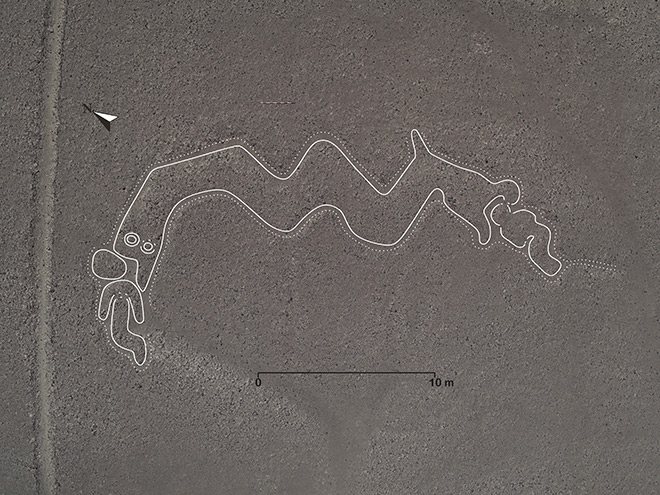
This image appears to be a two-headed snake feasting on humans
[Credit: Yamagata University]
143 new Nazca geoglyphs discovered
A geoglyph of what appears to be a human head headdress
[Credit: Yamagata University]


There are many more etchings waiting to be discovered, but the process of finding them has become harder. Many of the lines have been damaged by floods, roads, and urban expansion. The researchers believe they also span a far larger area than previously imagined, which would take significantly more time to search using traditional methods.

143 new Nazca geoglyphs discovered
This geoglyph is thought to depict a bird
[Credit: Yamagata University]
143 new Nazca geoglyphs discovered
This geoglyph appears to depict a human with animals
[Credit: Yamagata University]
143 new Nazca geoglyphs discovered
This geoglyph appears to depict someone wearing a headdress
[Credit: Yamagata University]


In a collaboration with IBM Research, the team is now deploying deep-learning algorithms to help speed up the hunt. The researchers are using a cloud platform to stitch together massive amounts of geospatial data, including lidar, drone, and satellite imagery and geographical surveys, to create high-fidelity maps of the search areas.


They are then training a neural network to recognize the data patterns of known lines to look for new ones. Even during testing, the team discovered a new design - a smaller humanoid figure - that had been missed in previously collected data. The discovery took only two months; previous methods had typically taken years.

Source: MIT Tehnology Review [November 19, 2019]

Scientists use modern technology to understand how ochre paint was created in rock art


Ochre, one of Earth's oldest naturally occurring materials, was often used as a vivid red paint in ancient rock art known as pictographs across the world. Despite its broad use throughout human history and a modern focus on how the artistic symbolism is interpreted, little research exists on the paint itself and how it was produced.

Scientists use modern technology to understand how ochre paint was created in rock art
One of the pieces of rock art found at Babine Lake. It is representative of the rock art
that was analyzed in the study [Credit: University of Missouri]
Now, scientists led by Brandi MacDonald at the University of Missouri are using archaeological science to understand how ochre paint was created by hunter-gatherers in North America to produce rock art located at Babine Lake in British Columbia.


"Ochre is one of the only types of material that people have continually used for over 200,000 years, if not longer," said MacDonald, who specializes in ancient pigments. "Therefore, we have a deep history in the archeological record of humans selecting and engaging with this material, but few people study how it's actually made."

This is the first study of the rock art at Babine Lake. It shows that individuals who prepared the ochre paints harvested an aquatic, iron-rich bacteria out of the lake -- in the form of an orange-brown sediment.

Scientists use modern technology to understand how ochre paint was created in rock art
In the study, the scientists heated a single grain of ochre and watched the effects of temperature change under
an electron microscope at MU's Electron Microscopy Core facility [Credit: University of Missouri]


In the study, the scientists used modern technology, including the ability to heat a single grain of ochre and watch the effects of temperature change under an electron microscope at MU's Electron Microscopy Core facility. They determined that individuals at Babine Lake deliberately heated this bacteria to a temperature range of approximately 750°C to 850°C to initiate the color transformation.

"It's common to think about the production of red paint as people collecting red rocks and crushing them up," MacDonald said. "Here, with the help of multiple scientific methods, we were able to reconstruct the approximate temperature at which the people at Babine Lake were deliberately heating this biogenic paint over open-hearth fires. So, this wasn't a transformation done by chance with nature. Today, engineers are spending a lot of money trying to determine how to produce highly thermo-stable paints for ceramic manufacturing or aerospace engineering without much known success, yet we've found that hunter-gatherers had already discovered a successful way to do this long ago."

The study was published in Scientific Reports.

Author: Eric Stann | Source: University of Missouri-Columbia [November 19, 2019]

3,000-year-old megalithic temple found in Peru


A 3,000-year-old megalithic 'water cult' temple used for fertility rituals has been discovered in Peru by a team of Peruvian archaeologists.

3,000-year-old megalithic temple found in Peru
Aerial view of the El Toro excavation site, where remains of a 3,000-year-old megalithic temple were
discovered in Oyotun, Chiclayo province, Labayeque department, Peru [Credit: AFP]
The religious monument is over 131ft long and is located in the springs of the Zana Valley river about 500miles from Lima, the modern capital of Peru.


Inside the temple archaeologists found a square with an altar that was likely used to offer important fertility rituals with water taken from the Zana Valley river.

3,000-year-old megalithic temple found in Peru
The temple is located in what is called the tinkuy, that is, the union of two rivers that were sacred spaces
in ancient cultures: the Nanchoc and Udima rivers to form the Zana [Credit: RPP News]
The religious monument is over 131ft long and includes the remains of large stone blocks and a central staircase

The megalith structure was found at the Huaca El Toro site in the Lambayeque region of Peru by a team led by Walter Alva, the archaeologist who discovered the tomb of the Lord of Sipan in 1987.

3,000-year-old megalithic temple found in Peru
It is the only megalithic structure that exists in the Lambayeque region. The facade and
all the side walls were built with large granite blocks [Credit: RPP News]
The temple still features the remains of large stone blocks and a long staircase. "This discovery is unique because it is the only megalithic architecture in Lambayeque," said Dr Alva.


The site was discovered in October but the news of its finding was delayed to reduce the risk of treasure hunters taking artefacts that hadn't been secured.

3,000-year-old megalithic temple found in Peru
A staircase at the El Toro excavation site [Credit: RPP News]
Archaeologists from Peru, seen here, found stunning walls surrounding the monument as well as a central altar likely used for fertility rituals.

The megalith structure was found at the Huaca El Toro site in the Lambayeque region of Peru by a team led by Walter Alva, the archaeologist who discovered the tomb of the Lord of Sipan in 1987.

3,000-year-old megalithic temple found in Peru
The graves date to after the temple was abandoned indicating that it was used
by the Chimus as a burial ground [Credit: RPP News]
The temple comes from a time when water was considered divine and was used in a number of rituals and religious practices, researchers claim. They were able to determine this temple was home to a cult that worshipped water by studying the way the altar is positioned and how it looks. The altar includes holes similar to those found on other temples from the period.


"This is typical of water altars that are in other places, and it is located in the springs of the Zana Valley river", Mr Alva said.

3,000-year-old megalithic temple found in Peru
Some 21 burials were found at the temple
[Credit: RPP News]
The temple was discovered by Walter Alva - pictured - who also discovered the tomb of the Lord of Sipan in 1987 in northern Peru.

Scientists found metal and ceramic objects in the graves discovered on the site, however most of the graves date from the later Inca period. They found a staircase on the site that was 32ft wide and 49ft long

3,000-year-old megalithic temple found in Peru
Some of the vessels placed as offerings in the graves
[Credit: RPP News]
Mr Alva said they have identified a circular column, where evidence of sedimentation of rains and rituals was found. 'This temple is facing the mountain. This place is strictly ceremonial because of the signs of burning that took place. The rituals were performed for fertility,' he said.


Stunning walls surround the monument and there is a central staircase that is 32ft wide and 49ft long.

3,000-year-old megalithic temple found in Peru
Peruvian archaeologist Walter Alva pointing to excavations
 at the site of El Toro [Credit: AFP]
The Peruvian team discovered 21 tombs on the site of the temple which is thought to date back to about 1,500 BC to 292 AD. Inside the tombs they found ceramic pieces and metal objects such as knives that were placed next to the graves.

Mr Alva says it is likely the tombs were later re-used as 20 of burial sites were from the later Inca Chimu culture which dates back to about 1,000 to 1,470 AD.

3,000-year-old megalithic temple found in Peru
Some of the huge blocks have petroglyphs suggesting that they were brought
 from a sacred place [Credit: RPP News]
This isn’t the first major discovery made by Walter Alva and his team. The archaeologist also discovered the tomb of the Lord of Sipan in 1987. Sipan was a ruler of Mochica culture and his remains were found intact in Northern Peru.

In 2007 he discovered a number of 4,000-year-old murals in Peru. They show a deer caught in a net and are thought to be the oldest murals in the Americas.

Author: Ryan Morrison | Source: Daily Mail [November 14, 2019]

Mammoth skeletons and 15,000-year-old human-built traps found in Mexico


Archaeologists said Wednesday they have made the largest-ever discovery of mammoth remains: a trove of 800 bones from at least 14 of the extinct giants found in central Mexico.

Mammoth skeletons and 15,000-year-old human-built traps found in Mexico
Mammoth skull and tusks in 15,000-year-old trap 
[Credit: INAH]
Moreover, they believe they have made the first-ever find of a mammoth trap set by humans, who would have used it to capture the huge herbivores more than 14,000 years ago, said Mexico's National Institute of Anthropology and History (INAH). "This is the largest find of its kind ever made," the institute said in a statement.


The skeletal remains were found in Tultepec, near the site where President Andres Manuel Lopez Obrador's government is building a new airport for Mexico City.

Mammoth skeletons and 15,000-year-old human-built traps found in Mexico
Archaeologists believe they have made the largest-ever discovery
of mammoth remains [Credit: INAH]
Mammoth skeletons and 15,000-year-old human-built traps found in Mexico
Mammoth bones excavated [Credit: INAH]
Mammoth skeletons and 15,000-year-old human-built traps found in Mexico
Luis Cordoba Barradas with mammoth remains
[Credit: INAH]


Mammoth skeletons and 15,000-year-old human-built traps found in Mexico
Mammoth pelvis [Credit: INAH]
Mammoth skeletons and 15,000-year-old human-built traps found in Mexico
Excavated Mammoth remains [Credit: Jose Mendez]
Mammoth skeletons and 15,000-year-old human-built traps found in Mexico
Mammoth skull [Credit: INAH]


Some bore signs that the animals had been hunted, leading experts to conclude that they had found "the world's first mammoth trap," it said.

"Mammoths lived here for thousands of years. The herds grew, reproduced, died, were hunted... They lived alongside other species, including horses and camels," archaeologist Luis Cordoba told journalists.


Researchers said at least five mammoth herds lived in the area of the find. Mexico has been the scene of surprising mammoth discoveries before. In the 1970s, workers building the Mexico City subway found a mammoth skeleton while digging on the capital's north side.

Source: AFP [November 07, 2019]

Fifteen pre-Hispanic burials discovered in Colombia


Archaeologists have uncovered 15 burials with the remains of a pre-Hispanic indigenous community on the grounds of the Pedagogical and Technological University of Colombia (UPTC) located in the city of Tunja in Northern Colombia.

Fifteen pre-Hispanic burials discovered in Colombia
Credit: UPTC - Universidad Pedagógica y Tecnológica de Colombia


The burials, which are believed to date back over 500 years, were found approximately 50 centimetres deep over an area of 1,500 square metres on the University grounds. About 500 kg of ceramic and lithic remains were also recovered at the site.

Fifteen pre-Hispanic burials discovered in Colombia
Credit: UPTC - Universidad Pedagógica y Tecnológica de Colombia


According to archaeologists, the characteristics of the findings suggest the remains belong to the Muisca people, who occupied the Andean Highland region of Colombia prior to the arrival of the Spaniards in 1537. There is a population of around 14,000 indigenous Muiscans still living in present-day Colombia.

Fifteen pre-Hispanic burials discovered in Colombia
Credit: UPTC - Universidad Pedagógica y Tecnológica de Colombia


Anthropologist working on the site Fabian Alvarez said: “We have the footprints, the vestiges of the footprints of the house and the graves of the people who probably lived here. Once we have cleaned and classified all these findings, they will help us answer a lot of questions.”


The findings will be given to the UPTC’s forensic laboratory, where they will be analysed for scientific purposes.

Source: UPTC - Universidad Pedagógica y Tecnológica de Colombia [November 05, 2019]